
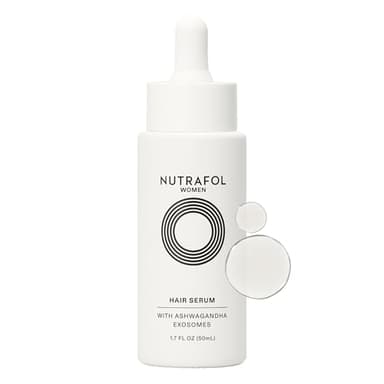
Nutrafol built its name on hair supplements, and it now sells a full line of products for your scalp and hair: two hair serums, a shampoo, a conditioner, a men's 2-in-1 and an exfoliating scalp mask. Searches for the shampoo and the serum now run to thousands a month, and most of what turns up repeats the brand's marketing. We read the ingredient lists, the clinical claims on the labels and the published research to answer one question: will they help with hair loss?
The short answer is no, not in the way the supplements might. These are cosmetics. They can make your scalp feel cleaner and your hair look and feel better, but none has been tested against a placebo for hair growth, and the evidence behind their headline ingredients is mostly from the lab.
The Nutrafol Topicals Line at a Glance
Prices are from Amazon on October 23, 2026. The "clinical claim" column is what Nutrafol's own label says its testing showed. All of these tests are company data on file, not published studies.
| Product | Price | What it is | Headline ingredients | What Nutrafol's clinical claim measured |
|---|---|---|---|---|
| Women's Hair Serum | $69 (1.7 fl oz) or $49 (1 fl oz) | Leave-on scalp serum, once a day | Ashwagandha exosomes, Irish moss, pea sprout extract | "Visibly thicker, stronger hair" |
| Men's Hair Serum | $49 (1 fl oz) | Leave-on scalp serum, once a day | Same base plus caffeine and red ginseng | "Visibly denser, stronger hair" |
| Root Purifier Shampoo | $44 (8.1 fl oz) | Sulfate-free shampoo | Australian wild berries, quinoa protein, prebiotics | Less dryness and flaking at once; less oil after 2 weeks |
| Strand Defender Conditioner | $44 (8.1 fl oz) | Rinse-out conditioner | Ximenia oil, babassu oil, arginine | Hair felt more hydrated after 2 weeks |
| Men's 2-in-1 Shampoo and Conditioner | $44 (8.1 fl oz) | Shampoo and conditioner in one | Fermented pomegranate, mushroom extracts | Less dryness and flaking after 2 weeks |
| Exfoliating Scalp Mask | $49 (4 fl oz) | Weekly scalp scrub | Fruit acids (AHAs), jojoba beads | Less product build-up right after use |
Nutrafol also sells a Strand Serum for the lengths of the hair, which makes breakage and heat-protection claims rather than scalp or hair-loss ones.
What the Evidence Shows
There is no placebo-controlled trial of any Nutrafol topical. We searched PubMed for every Nutrafol and Nutraceutical Wellness publication. The only paper on the scalp products is a 2023 continuing-education supplement in the Journal of Clinical and Aesthetic Dermatology, written by three Nutrafol employees and funded by the company PMID: 38495927. That is not the same thing as an independent trial measuring hair counts against a placebo, which is what Nutrafol's supplements have.
The wording on the labels is a clue. In the US, a product meant to grow hair or stop hair loss is regulated as a drug, and since 1989 the FDA has held that no ingredient sold over the counter as a topical hair grower is proven safe and effective (21 CFR 310.527). Minoxidil is sold under its own drug approval. A cosmetic can only promise how hair looks and feels. That is why the serum promises "visibly thicker" hair rather than more hair.
Nutrafol's own test results are about scalp comfort, not growth. The shampoo listing reports that every tester saw less dryness and flaking straight away and less oil after two weeks. The conditioner's claim is that 94% of women felt their hair was more hydrated. The mask's claim is less product build-up. These are fair things for a shampoo to do, but they are not hair-loss results.
Nutrafol Hair Serum (Women's): Ingredient by Ingredient
Here is the full ingredient list from the Amazon listing:
Aqua, Glycerin, Melaleuca Alternifolia (Tea Tree) Leaf Water, Propanediol, 1,2-Hexanediol, Niacinamide, Panthenol, Hydroxyethylcellulose, Lepidium Meyenii (Maca) Root Extract, Maltodextrin, Caprylhydroxamic Acid, Equisetum Arvense (Horsetail) Extract, Hippophae Rhamnoides (Sea Buckthorn) Fruit Extract, Laminaria Saccharina (Neptune Kelp) Extract, Chondrus Crispus (Seaweed) Extract, Sodium Metabisulfite, Alcohol, Arginine, Phospholipids, Lactic Acid, Melatonin, Potassium Sorbate, Lactobacillus Ferment, Pisum Sativum (Pea Sprout) Extract, Phosphate Buffered Saline, Withania Somnifera Seed Exo Extract
How to read the order. US labeling rules require ingredients present at more than 1% to be listed in descending order, while those at 1% or less can follow in any order (21 CFR 701.3). Nutrafol does not publish concentrations. But the ingredient it leads with, the ashwagandha exosome extract (Withania Somnifera Seed Exo Extract), is listed last, after the preservatives and the buffer it is suspended in. It is almost certainly present at 1% or less.
What each of the active-sounding ingredients brings:
- Niacinamide and panthenol. These sit near the top of the list, at a meaningful level. They are well-established conditioning and skin-barrier ingredients, which is why the serum can make the scalp feel comfortable and hair feel better. Neither is a hair-growth drug. Our scalp serums guide covers what they can and cannot do.
- Ashwagandha exosomes. In a 2026 lab study, tiny vesicles extracted from the ashwagandha plant kept donated human hair follicles in their growth phase for longer in a dish PMID: 42494309. That is a genuine early finding, but it was not tested on people, and the paper declares that Nutrafol's maker and Unilever have a commercial interest in ashwagandha. One author is a former Nutrafol employee.
- Melatonin. This is the ingredient with the best human data. In a small double-blind trial, 40 women applied a 0.1% melatonin solution or a placebo to the scalp every day for six months, and the melatonin group had a higher share of hairs in the growth phase in some scalp areas PMID: 14996107. Later open studies of a commercial melatonin solution reported less shedding PMID: 23766606. Nutrafol does not say how much melatonin its serum contains, and it is listed near the end.
- Pea sprout extract. A short report by the ingredient's manufacturer found that a 2% pea sprout lotion raised two hair-related genes in the scalps of 10 volunteers, and a separate 21-person pilot of the extract taken by mouth reported less shedding after eight weeks PMID: 31680356. Neither part had a placebo group. Here it is the second-last ingredient.
- Irish moss (Chondrus crispus). Nutrafol markets "Irish moss peptides". We found no published hair studies.
- Maca, horsetail, sea buckthorn and kelp. Botanical extracts with antioxidant or conditioning roles in cosmetics, and no topical hair-growth trials.
What we like. The serum contains no added fragrance and little alcohol, which makes it gentler than many scalp serums. It is light and does not leave hair greasy. Its 4.1-star rating on Amazon from more than 3,000 reviews suggests most buyers find it pleasant to use.
What we don't. At $69 for 1.7 fl oz it is expensive for a cosmetic. Its marketing leads with an ingredient present in trace amounts that has never been tested on a human scalp, and nothing in it is proven to regrow hair.
Nutrafol Men's Hair Serum
The men's version uses the same base and adds three ingredients: caffeine, which is sixth on the list and so present in a meaningful amount, plus red ginseng (Panax ginseng) and moringa, both near the end.
Caffeine is the most interesting addition. A 2025 systematic review found nine clinical trials of topical caffeine products for hair loss, with 684 people in total. All reported benefits, but the authors rated the evidence as medium in three studies and low or very low in the other six, mostly because of missing placebo groups and undisclosed caffeine concentrations PMID: 39997270. The best-known study gave 210 men either a 0.2% caffeine liquid or 5% minoxidil for six months and found similar improvements. It was open-label with no placebo group PMID: 29055953. Red ginseng has mostly animal and lab data for hair.
So the men's serum has one ingredient with modest, low-quality human evidence, at an unpublished dose. That makes it slightly more defensible than the women's serum, but it is still not a substitute for minoxidil or finasteride.
Nutrafol Shampoo, Conditioner and Scalp Mask
Root Purifier Shampoo. It cleans with sodium cocoyl sarcosinate and sodium C14-16 olefin sulfonate. It is free of sodium lauryl and laureth sulfate, which is what "sulfate-free" means here, but it is still an effective cleanser. Its botanicals (riberry and Tasmanian pepperberry fruit extracts, listed as Syzygium luehmannii and Tasmannia lanceolata) and hydrolyzed quinoa appear near the end. It contains fragrance. It has no anti-dandruff or hair-loss active: no ketoconazole, zinc pyrithione, piroctone olamine or selenium sulfide. Nutrafol highlights that the scalp line is certified "microbiome-friendly" by MyMicrobiome, a private certification that the products do not disrupt the scalp's bacteria. It says nothing about hair growth.
Strand Defender Conditioner. A standard silicone-free conditioner with plant oils, wheat protein and arginine. It contains fragrance and several fragrance allergens (citral, geraniol, limonene and linalool), which matters if your scalp is sensitive. Rosemary extract appears near the middle of the list. That is not the same as the rosemary oil studied for hair; see our rosemary oil guide.
Men's 2-in-1 Shampoo and Conditioner. A combined shampoo and conditioner with fermented pomegranate, a reishi mushroom extract and konjac root. Like the women's shampoo, it contains fragrance and no hair-loss active.
Exfoliating Scalp Mask. It uses fruit acids (AHAs) and jojoba beads to lift oil and the build-up left by dry shampoo and styling products. That is a real cosmetic job. If you have flaking, itch or redness, a medicated shampoo treats the likely cause, seborrheic dermatitis, more effectively.
Why a shampoo can't do much for hair loss. A shampoo is on your scalp for a minute or two before you rinse it away. The one shampoo ingredient with published hair-loss data is ketoconazole. In a small 1998 study of people with androgenetic alopecia, those using 2% ketoconazole shampoo saw improvements in hair density and in the share of growing hairs similar to those using 2% minoxidil PMID: 9669136. The authors said a larger controlled study was needed. Ketoconazole 1% (Nizoral) costs a fraction of Nutrafol's shampoo. See our ketoconazole guide and our DHT shampoo rankings.
Nutrafol Topicals vs Proven Options
| Nutrafol Hair Serum | Minoxidil 5% | Nutrafol Shampoo | Ketoconazole shampoo | |
|---|---|---|---|---|
| Regulatory status | Cosmetic | FDA-approved drug for hair loss | Cosmetic | Anti-dandruff drug (1% OTC) |
| Placebo-controlled trials for hair growth | None | Many, in men and women | None | Small studies only, no large trials |
| What it can do | Condition the scalp and hair | Regrow hair in many users | Clean the scalp; ease dryness and oil | Treat dandruff and seborrheic dermatitis; may modestly help hair density |
| Main downside | Price; unproven | Initial shedding; must be used for life | Price; fragrance | Can dry the hair |
Minoxidil has side effects worth knowing about, including an early shed and occasional scalp irritation; see our minoxidil side effects guide.
Side Effects and Safety
These are cosmetics, and the main risk is scalp irritation or allergy. The shampoo, conditioner and 2-in-1 contain fragrance, and the conditioner also lists common fragrance allergens. The serums contain tea tree leaf water and a sulfite preservative (sodium metabisulfite), both of which can occasionally irritate. Patch-test a small area first if your skin is reactive, and stop if you develop redness, itch or a rash.
There is no known reason the topicals would interact with minoxidil, finasteride or Nutrafol supplements. The ashwagandha in the serum is a tiny topical amount. The rare liver problems linked to ashwagandha come from supplements taken by mouth, which our Nutrafol review covers.
Who Should and Shouldn't Buy Them
They are a reasonable buy if you already use a proven treatment, want a pleasant, gentle scalp-care routine and are happy to pay for it. The shampoo and mask are good at their cosmetic jobs, and the women's serum is one of the gentler leave-on serums because it has no added fragrance.
Skip them if you are buying them to stop hair loss. If your hair is thinning in a pattern (a widening part, a thinning crown or a receding hairline), put the money towards minoxidil for men or minoxidil for women first. If your scalp is flaky or itchy, use a ketoconazole shampoo. If you are shedding heavily all over, see a doctor and get blood tests for iron and thyroid problems before buying anything.
Our Verdict
Nutrafol's shampoo and serum are well-made cosmetics sold with the language of a hair-loss treatment. Neither has been tested against a placebo for hair growth, the only published paper on them comes from the company, and the serum's headline ingredient appears in trace amounts with only lab evidence behind it.
Our ratings:
- Women's Hair Serum: 2.5 out of 5. Gentle, fragrance-free and pleasant to use, but expensive and unproven for hair growth.
- Men's Hair Serum: 2.5 out of 5. The added caffeine has some low-quality human evidence, but at an undisclosed dose, so it does not change our view.
- Root Purifier Shampoo: 2.5 out of 5. A good sulfate-free shampoo at three to four times the price of a good drugstore one, with no hair-loss active.
If you like them, they will not do harm, and they can sit alongside proven treatment. They should not replace it.
Proven alternatives:
Sources
- Townsend N, Hazan A, Dell'Acqua G. New topicals to support a healthy scalp while preserving the microbiome: a report of clinical and in vitro studies. Journal of Clinical and Aesthetic Dermatology. 2023;16(10 Suppl 1):S4-S11. Funded by Nutraceutical Wellness. PMID: 38495927.
- Le Riche A, Nienhaus J, Silva E Sousa M, et al. Treatment with ashwagandha-derived exosome-like nanovesicles up-regulates VEGF-A production and promotes human hair growth ex vivo. Experimental Dermatology. 2026;35(7):e70315. PMID: 42494309.
- Fischer TW, Burmeister G, Schmidt HW, Elsner P. Melatonin increases anagen hair rate in women with androgenetic alopecia or diffuse alopecia: results of a pilot randomized controlled trial. British Journal of Dermatology. 2004;150(2):341-345. PMID: 14996107.
- Fischer TW, Trüeb RM, Hänggi G, Innocenti M, Elsner P. Topical melatonin for treatment of androgenetic alopecia. International Journal of Trichology. 2012;4(4):236-245. PMID: 23766606.
- Grothe T, Wandrey F, Schuerch C. Short communication: clinical evaluation of pea sprout extract in the treatment of hair loss. Phytotherapy Research. 2020;34(2):428-431. PMID: 31680356.
- Szendzielorz E, Spiewak R. Caffeine as an active ingredient in cosmetic preparations against hair loss: a systematic review of available clinical evidence. Healthcare (Basel). 2025;13(4):395. PMID: 39997270.
- Dhurat R, Chitallia J, May TW, et al. An open-label randomized multicenter study assessing the noninferiority of a caffeine-based topical liquid 0.2% versus minoxidil 5% solution in male androgenetic alopecia. Skin Pharmacology and Physiology. 2017;30(6):298-305. PMID: 29055953.
- Piérard-Franchimont C, De Doncker P, Cauwenbergh G, Piérard GE. Ketoconazole shampoo: effect of long-term use in androgenic alopecia. Dermatology. 1998;196(4):474-477. PMID: 9669136.
- U.S. Code of Federal Regulations. 21 CFR 310.527: drug products containing active ingredients offered over-the-counter for external use as hair growers or for hair loss prevention.
- U.S. Code of Federal Regulations. 21 CFR 701.3: designation of ingredients (cosmetic labeling).
- Amazon listings for Nutrafol Women's Hair Serum, Men's Hair Serum, Root Purifier Shampoo, Strand Defender Conditioner, Men's 2-in-1 Shampoo and Conditioner, Exfoliating Scalp Mask and Strand Serum (ingredient lists, label claims and prices), accessed October 23, 2026.
See also: