
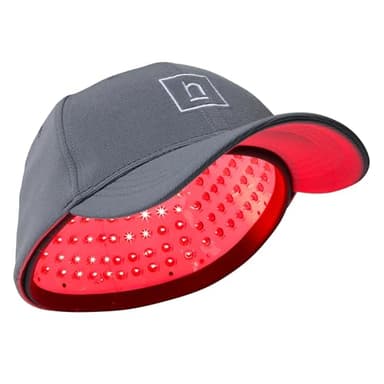
Laser caps are one of the most heavily marketed categories in hair loss, and HairMax is one of the oldest names in the space. The PowerFlex 202 is the entry model in HairMax's flexible-cap line. Is it a legitimate device or expensive theater? Here's the honest review: what it is, what the evidence actually supports, and who should (and shouldn't) buy one.
What the PowerFlex 202 Is
The HairMax PowerFlex 202 is a low-level laser therapy (LLLT) device: a flexible cap embedded with 202 medical-grade laser diodes that you wear under a regular hat or cap during a treatment session. It's cordless and rechargeable, and it's FDA-cleared for the treatment of androgenetic alopecia in both men and women — meaning it cleared the regulatory bar for safety and demonstrated a treatment effect.
The "flexible" design is the selling point over rigid caps: the cap conforms to different head shapes, which helps the diodes sit closer to the scalp for more even light delivery.
Does LLLT Actually Work? The Honest Evidence
This is where you need a clear head, because the category is oversold. Here's the balanced picture:
- The mechanism is real. LLLT (also called red-light or photobiomodulation therapy) is thought to stimulate follicles that are still capable of growth, extending the growth phase of the hair cycle.
- The evidence is modest but genuine. Peer-reviewed trials and systematic reviews of LLLT devices show statistically significant but small improvements in hair density versus sham devices in early-stage androgenetic alopecia. It's a real effect — just not a large one.
- It is an adjunct, not a cure. The effect size is smaller and less consistent than minoxidil or finasteride. LLLT is best used alongside proven treatments, not instead of them.
- Consistency is everything. Results require months of regular sessions, and they fade if you stop. This is an ongoing commitment, not a one-time purchase.
If a review promises a laser cap will regrow a Norwood 5 crown on its own, close the tab. Used realistically — early-stage loss, consistent use, layered with proven treatments — a device like the PowerFlex 202 can add incremental benefit.
202 vs 272: Which HairMax Cap?
The number is the diode count. The 202 has 202 laser diodes; the step-up 272 has 272. More diodes mean more scalp coverage per session, so the 272 treats a larger area slightly more efficiently. Both share the same flexible-cap design and the same LLLT mechanism.
For most early-stage users, the 202 is the sensible entry point — it delivers the same therapy at a lower price. The 272 is worth the premium mainly if you want maximum coverage or have more diffuse thinning across a larger area.
A note on our links: the buttons on this page go to the PowerFlex 272 on Amazon, the HairMax cap we can currently link. If you have settled on the 202, compare its price at HairMax or another retailer before buying.
Who Should Buy It
A laser cap like the PowerFlex 202 makes sense if you:
- Have early-stage thinning (it can't revive long-dead follicles)
- Will actually use it consistently for 6-12+ months
- Want a drug-free mechanism to add to your routine
- Are already using — or plan to use — minoxidil and/or finasteride and want to layer therapies
- Can't tolerate topical or oral medications and want another lever
It's probably not for you if you:
- Expect it to work on its own without proven treatments
- Have advanced hair loss with extensive smooth scalp
- Won't commit to the ongoing routine
- Are choosing it instead of minoxidil/finasteride to save effort
How It Compares to Other Caps
The PowerFlex 202 competes with caps like the iRestore, Kiierr, and Capillus. They differ mainly in diode count, coverage, session length, and price — the core LLLT mechanism is the same across all of them. For a full side-by-side of the leading devices, see our best laser caps ranking and our breakdown of laser caps vs combs vs helmets.
HairMax PowerFlex 202 Review: The Bottom Line
The HairMax PowerFlex 202 is a legitimate, FDA-cleared LLLT device, and the 202-diode model is a reasonable, more affordable entry into laser therapy. Just calibrate your expectations: LLLT delivers modest gains, works only with consistent months-long use, and is best as an adjunct to minoxidil and finasteride — not a replacement. Bought with those expectations, it's a fair addition to an evidence-based routine. Bought as a shortcut around proven treatments, it will disappoint.
Frequently Asked Questions
Does the HairMax PowerFlex 202 actually work?
It can help modestly. The PowerFlex 202 delivers low-level laser therapy (LLLT), which has FDA clearance and peer-reviewed evidence for slowing hair loss and producing small increases in hair density in early-stage androgenetic alopecia. The effect size is smaller and less consistent than minoxidil or finasteride, and it only works with consistent use over months. Think of it as an adjunct that can add to a proven regimen, not a standalone cure.
What's the difference between the HairMax PowerFlex 202 and 272?
The number refers to the count of medical-grade laser diodes: the 202 has 202 diodes and the 272 has 272. More diodes mean more scalp coverage per session, so the 272 can treat a larger area slightly more efficiently. Both use the same flexible-cap design and the same underlying LLLT mechanism. The 202 is the more affordable entry point and is sufficient for most early-stage users; the 272 is worth the premium mainly if you want maximum coverage.
How long until you see results with a laser cap?
Plan on at least 4-6 months of consistent use before judging results, with better outcomes closer to 12 months. LLLT works gradually by stimulating follicles still in the growth-capable phase. If you stop, gains fade, so it's an ongoing commitment. Anyone promising fast, dramatic regrowth from a laser cap alone is overselling it.
Is a laser cap better than minoxidil or finasteride?
No. Minoxidil and finasteride have stronger, more consistent evidence and are the foundation of any evidence-based regimen. A laser cap like the PowerFlex 202 is best used as an add-on for people who want a drug-free extra mechanism, can't tolerate other treatments, or want to layer therapies. Used alongside minoxidil and/or finasteride, LLLT may add incremental benefit — but it's not a substitute.
Sources
- Afifi L, et al. Low-level laser therapy as a treatment for androgenetic alopecia. Lasers in Surgery and Medicine. 2017.
- Jimenez JJ, et al. Efficacy and safety of a low-level laser device in the treatment of male and female pattern hair loss: a multicenter, randomized, sham device-controlled, double-blind study. American Journal of Clinical Dermatology. 2014.
- Our best laser caps ranking and laser caps vs combs vs helmets.
Our top pick
HairMax PowerFlex 272
A legitimate FDA-cleared LLLT cap from one of the oldest names in laser therapy — best used alongside proven treatments.