
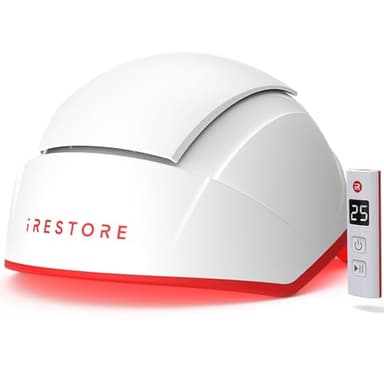
Every low-level laser therapy device on the market — cap, comb, or helmet — emits the same red light in roughly the same 650 nm range, and the biological mechanism they're leaning on is identical. What differentiates a $150 comb from a $700 cap isn't the light. It's the form factor: how much of your scalp it actually reaches per session, how long you have to sit there operating it, and whether that routine survives contact with a real week.
What LLLT Actually Does
Low-level laser therapy (LLLT) uses red light, typically in the 650–670 nm range, delivered directly to the scalp. The proposed mechanism is photobiomodulation: red light photons are absorbed by mitochondria in follicle cells, which is thought to increase cellular energy production (ATP) and shift miniaturized follicles back toward a more active growth phase. It's a plausible, mechanistically distinct pathway from minoxidil (vasodilation, anagen prolongation) and finasteride (DHT suppression).
Several devices, across cap, comb, and helmet form factors, have FDA clearance for androgenetic alopecia via the 510(k) pathway. It's worth being precise about what that clearance means: it establishes the device is substantially equivalent to already-cleared products and reasonably safe, not that it produces dramatic regrowth. Randomized, sham-controlled trials do show statistically significant improvements in hair count and density with real LLLT devices versus sham devices — that's genuine evidence, not just marketing. But the effect size is consistently smaller than what's documented for minoxidil or finasteride. LLLT is best understood as an adjunct that can add incremental density on top of a foundation, not a device that replaces one.
The other honest caveat: nothing about form factor changes the wavelength or the mechanism. A cap, a comb, and a helmet using the same diode specification are delivering the same treatment. The question that actually matters when comparing them is adherence — will you use it three times a week for the four to six months the trials suggest are necessary to see anything.
Caps
Caps are the dominant form factor for a practical reason: they're hands-free. You put it on, start the session, and go do something else — read, work, watch television — while diodes distributed across the entire dome deliver light to your whole scalp simultaneously. That combination of even coverage and zero hands-on effort is what drives adherence, and adherence is the single biggest predictor of whether an LLLT device produces any visible result at all.
Best overall
iRestore Professional
Best For
Best clinical data-to-price ratio
Works In
4-6 months
Price
$899.00
as of Oct 18
Pros
- ✓Clinical trial showing meaningful average hair count increase in 4 months
- ✓282 lasers and LEDs — full scalp coverage
- ✓FDA cleared via 510(k) pathway
- ✓Hands-free cap design allows use during other activities
Cons
- ✗Mix of lasers and LEDs, not all diodes are true lasers
- ✗25-minute sessions required every other day
- ✗Clinical trial was company-sponsored
Best value
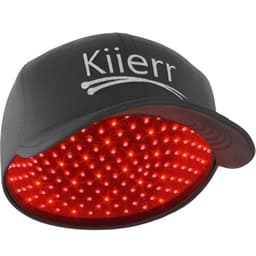
Kiierr 272 Premier
Best For
Best value at a high diode count
Works In
4-6 months
Price
$1,099.99
as of Oct 18
Pros
- ✓272 laser diodes for full-scalp coverage
- ✓FDA cleared
- ✓Lightweight cap with rechargeable battery
- ✓30-minute hands-free sessions
Cons
- ✗Less published clinical data than the market leaders
- ✗Newer brand — limited long-term real-world data
- ✗Company-sponsored clinical data only
Lowest entry price
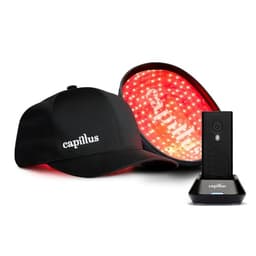
Capillus Red Light Therapy
Best For
Best entry price for an FDA-cleared cap
Works In
4-8 months
Price
$2,399.00
as of Oct 18
Pros
- ✓Most affordable FDA-cleared laser cap
- ✓6-minute daily treatment sessions
- ✓Lightweight and discreet under a hat
- ✓FDA cleared
Cons
- ✗Fewer diodes than higher-priced caps — reduced coverage density
- ✗Shorter session may deliver a lower total energy dose
- ✗Less published clinical trial data for this specific model
Combs
A laser comb is the cheapest way into LLLT, and that's really the only thing recommending it. Instead of diodes distributed across a dome that sits on your head, a comb has a small strip of diodes that you move across your scalp yourself, section by section, for the entire session — typically 8 to 15 minutes, several times a week, holding the device the whole time.
That design has two structural problems. First, coverage is only as good as your technique: it's easy to miss patches, especially at the crown, where you can't see what you're doing. Second, and more important, it demands active attention for the full session. You can't read or half-watch television while methodically dragging a comb through your hair — you have to be doing it. That's a meaningfully higher time-and-effort cost than putting on a cap, and it shows up in adherence data: comb users are more likely to skip sessions and more likely to abandon the routine within the first few months, well before the four-to-six-month window where results might appear.
(Prefer a hands-free cap? HairMax also makes the PowerFlex 202 laser cap — see our full review.)
If you're confident you'll actually do the comb routine consistently, the light itself works the same way. Most people aren't that disciplined, which is why a cap is the better default recommendation.
Helmets
Helmets sit between caps and combs in price and largely match caps in results — they're hands-free, distribute diodes across the whole scalp, and don't require active technique during a session. The tradeoff is size and portability. A helmet is bulkier than a cap, harder to wear discreetly, and less practical if you travel or want to use the device while doing anything other than sitting still at home. For someone who mostly treats at a fixed time in a fixed place, a helmet is a reasonable equivalent to a cap. For someone who wants to use the device while working, commuting, or moving around the house, a cap's lower profile makes it the more realistic long-term choice.
The best-known laser helmets are the Theradome PRO LH80 (100% lasers, a short 20-min, 2×/week protocol) and the iRestore Elite (broadest coverage, though its "500 lights" are part LED).
The Diode-Count Marketing Trap
Laser cap marketing leans hard on diode counts — 82, 148, 272, 282 — as though they were a straightforward performance metric where more always equals better. Coverage matters up to the point where the whole scalp is being reached; past that point, additional diodes mostly duplicate light on areas already being treated. What the trials actually measure is total energy delivered to thinning areas over a session, not a raw diode tally.
In practice, a device needs enough diodes, spaced appropriately, to reach the full scalp — that floor is roughly 80 or more for a cap, depending on spacing and coverage design. A 272-diode cap is not three times as effective as an 80-diode cap that already achieves full coverage; it may deliver a modestly higher energy dose per session, but the difference is nowhere near proportional to the diode-count difference advertised on the box. When comparing devices, look at documented coverage area and session protocol before treating diode count as the deciding factor.
Where It Fits in a Real Routine
LLLT works best as an addition, not a replacement. The three major androgenetic alopecia treatment mechanisms — DHT suppression (finasteride), anagen-phase extension and vasodilation (minoxidil), and photostimulation of follicle mitochondria (LLLT) — are independent of one another, and their effects appear additive rather than competing. For someone already on minoxidil or finasteride who wants incremental density on top of that foundation, a laser device is the most evidence-supported add-on available. For someone starting from nothing, spending $600–700 on a cap before starting minoxidil is the wrong order of operations — minoxidil and finasteride have larger, better-documented effects at a fraction of the cost.
However you use it, treat four to six months of three-times-weekly sessions as the minimum commitment before judging results, and read our full laser therapy treatment guide for the underlying mechanism and evidence in more depth. For device-specific comparisons across the cap market, see our best laser caps rankings.
Frequently Asked Questions
Do laser caps actually regrow hair?
Modestly, and only for some people. Low-level laser therapy has FDA clearance for androgenetic alopecia and several randomized trials show small but statistically significant increases in hair density over 16 to 26 weeks. The effect is smaller than minoxidil or finasteride. Treat it as an adjunct, not a foundation.
How many diodes do I actually need?
Enough to cover your scalp, which in practice means roughly 80 or more for a cap. Beyond that, diode count is largely a marketing number. What matters is total energy delivered to the scalp over a session and whether every thinning area receives light. A 272-diode cap is not triple the results of an 80-diode cap.
How long until laser therapy shows results?
Four to six months of consistent use, three times per week. The published trials measured outcomes at 16 and 26 weeks. Nothing visible happens in the first two months. Devices are expensive, so decide up front whether you will genuinely use it for six months before spending the money.
Can I use a laser cap with minoxidil and finasteride?
Yes, and that combination is where laser therapy makes the most sense. The mechanisms are independent: light therapy is thought to act on mitochondrial activity in the follicle, minoxidil on the growth phase, finasteride on DHT. There are no known interactions between them.
Are laser combs worth it?
Rarely. A comb costs less but requires you to hold it and move it methodically across the scalp for the whole session, several times a week. Coverage is uneven and adherence collapses. The cheaper device you abandon in month two is more expensive than the cap you actually use.
Our top pick
iRestore Professional
If you'll actually use it three times a week, a cap beats a comb or helmet on coverage and comfort — iRestore is our pick.
Sources
- Jimenez JJ, Wikramanayake TC, Bergfeld W, et al. Efficacy and safety of a low-level laser device in the treatment of male and female pattern hair loss: a multicenter, randomized, sham device-controlled, double-blind study. American Journal of Clinical Dermatology. 2014;15(2):115-127. PMCID: PMC3944668.
- Afifi L, Maranda EL, Zarei M, et al. Low-level laser therapy as a treatment for androgenetic alopecia. Lasers in Surgery and Medicine. 2017;49(1):27-39.
- Retzlaff B, Tully A, Friedman A. Low-level laser therapy for hair loss: a 7-RCT meta-analysis confirming statistically significant improvements across all FDA-cleared devices. Lasers in Medical Science. 2021. PMCID: PMC8675345.
- Zarei M, Wikramanayake TC, Falto-Aizpurua L, Schachner LA, Jimenez JJ. Low level laser therapy and hair regrowth: an evidence-based review. Lasers in Medical Science. 2016;31(2):363-371.
- U.S. Food and Drug Administration. 510(k) Premarket Notification database — laser hair growth devices. fda.gov/medical-devices. Accessed March 2026.