Minoxidil has been FDA-approved for hair loss since 1988. It is the most widely used hair loss treatment in the world, available over the counter in the 2% and 5% concentrations. It works. And because the patent expired decades ago, the exact same molecule is sold under several labels — so the brand you choose changes the price, not the result.
This guide covers what minoxidil actually does, how to use it properly, and which products are worth your money.
Quick Answer
Kirkland 5% Foam is identical to Rogaine 5% Foam in active ingredient and concentration, and no trial shows a difference in results — but it costs about 30% less per month (~$12 vs ~$17 as multipacks). Unless you have a specific reason to pay for a brand, Kirkland is the right call for most men.
How Does Minoxidil Work?
Minoxidil was originally developed as an oral antihypertensive (blood pressure) drug in the 1970s. Researchers noticed that patients taking oral minoxidil had a surprising side effect: increased hair growth. The topical formulation was developed specifically to leverage this effect on the scalp.
The exact mechanism remains not fully understood, but the main pathways are:
Vasodilation: Minoxidil is a potassium channel opener and vasodilator. Applied topically to the scalp, it dilates blood vessels around hair follicles, potentially increasing delivery of oxygen and nutrients to the follicle.
Anagen phase prolongation: Minoxidil extends the growth (anagen) phase of the hair cycle, giving follicles more time to produce longer, thicker hair shafts before entering the resting phase.
Follicle enlargement: Over time, minoxidil appears to increase the size of miniaturized hair follicles — a key mechanism for treating androgenetic alopecia, where follicles progressively shrink.
What minoxidil does not do: it does not block DHT (the androgen responsible for follicle miniaturization in pattern hair loss). This is why combining minoxidil with finasteride produces better results than either alone — they address complementary pathways.
Men's vs. Women's Formulations
Men's 5% foam or solution is FDA-approved for androgenetic alopecia (male pattern baldness) applied twice daily. This is the strongest OTC formulation.
Women's 2% solution (Rogaine for Women) is FDA-approved for use once daily in women with diffuse thinning at the crown. The lower concentration was chosen based on clinical trials that showed it was effective for women while minimizing the risk of unwanted facial hair growth.
Women using 5%: Many dermatologists do use 5% topical minoxidil off-label in women, particularly the foam formulation (lower systemic absorption than the solution). Clinical data supports 5% efficacy in women — a 2004 study found 5% minoxidil produced 45% more hair regrowth than 2% in women at 48 weeks. The tradeoff is higher risk of hypertrichosis (facial hair). Talk to a dermatologist before using the men's 5% as a woman.
Low-dose oral minoxidil: The fastest-growing development in minoxidil use is the oral route. Multiple well-conducted clinical trials (2019-2024) show that 0.625-2.5mg oral minoxidil daily produces significant hair density improvement in women, and 2.5-5mg in men. The advantages: once-daily pill instead of twice-daily scalp application, potentially higher compliance, and systemic coverage for diffuse loss. Downside: fluid retention (more common at higher doses), increased body hair, requires a prescription. This option is available through the telehealth platforms we cover (Hims, Keeps, Ro).
Our Rankings
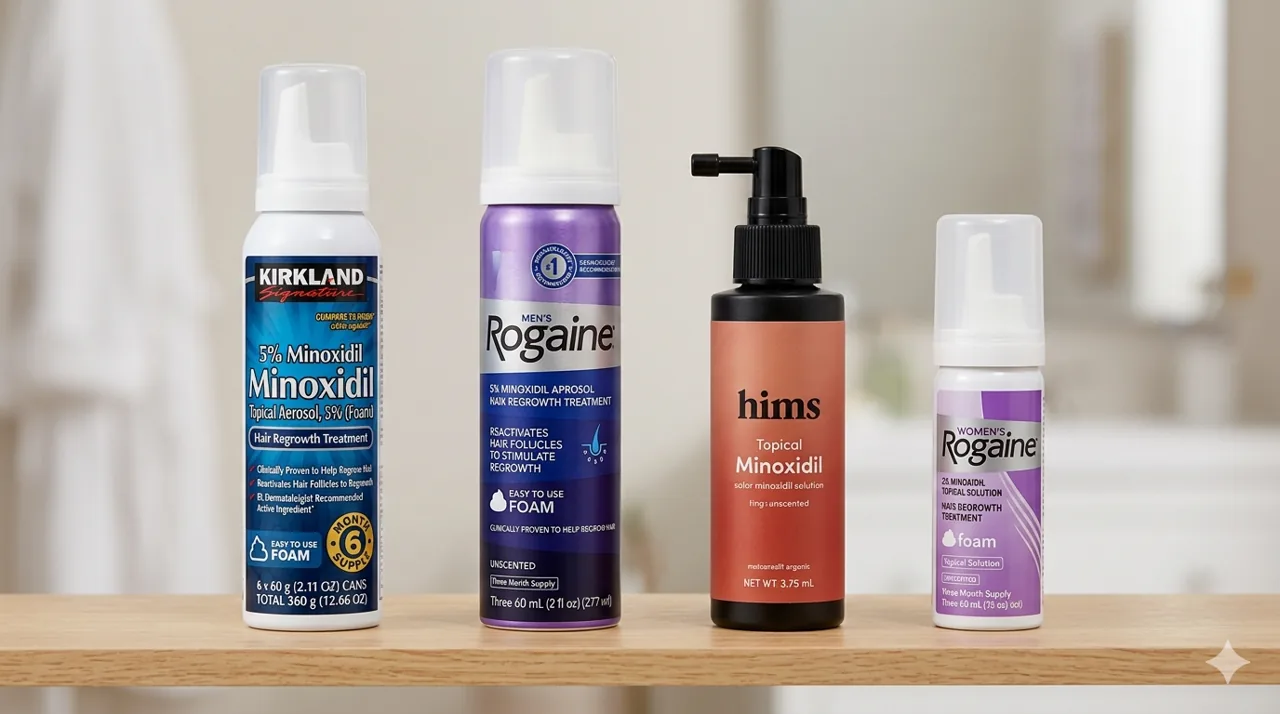
Kirkland Signature 5% Minoxidil Foam
Best For
Men, pattern hair loss
Works In
3-6 months
Price
~$12/mo (sold as a 6-month pack)
Pros
- ✓Identical to Rogaine 5% Foam — same active ingredient, same concentration
- ✓About 30% cheaper per month than brand-name Rogaine
- ✓Foam formula reduces scalp irritation vs. liquid
- ✓Widely available and in stock at Costco and Amazon
Cons
- ✗No loyalty reward programs or branded experience
- ✗Foam can feel greasy to some users
- ✗Requires twice-daily application for full efficacy
We earn 4%/sale if you sign up · See all commissions
Rogaine 5% Minoxidil Foam (Men's)
Best For
Men, pattern hair loss
Works In
3-6 months
Price
~$17/mo (sold as a 3-month pack)
Pros
- ✓Original brand with decades of clinical evidence
- ✓Easy-to-use foam applicator
- ✓Widely studied and trusted by dermatologists
- ✓Subscribe & Save options reduce cost somewhat
Cons
- ✗~30% more per month than Kirkland for an identical active ingredient
- ✗No evidence of better efficacy than generic
- ✗Still requires twice-daily application
We earn 4%/sale if you sign up · See all commissions
Hims Topical Minoxidil Solution
Best For
Men who want telehealth convenience
Works In
3-6 months
Price
~$15/mo (subscription)
Pros
- ✓Physician-supervised — convenient for existing Hims subscribers
- ✓Can be combined with finasteride prescription in one platform
- ✓Good pricing for a branded telehealth product
- ✓Progress tracking features in the app
Cons
- ✗Requires Hims subscription
- ✗Liquid solution (not foam) — slightly higher irritation risk
- ✗More expensive than Kirkland for equivalent result
We earn $50-100/signup if you sign up · See all commissions
Women's Rogaine 2% Minoxidil Solution
Best For
Women, diffuse thinning at crown
Works In
4-8 months
Price
~$17/mo (sold as a 3-month pack)
Pros
- ✓FDA-approved specifically for women
- ✓Lower concentration reduces facial hair risk
- ✓Once-daily application (vs. twice daily for 5%)
- ✓Good evidence base across multiple trials
Cons
- ✗2% concentration shows somewhat less efficacy than 5%
- ✗Solution formulation can be messy
- ✗More expensive per mg of active ingredient than men's generics
We earn 4%/sale if you sign up · See all commissions
What Minoxidil Actually Costs
Minoxidil is not a course you finish. Stopping reverses your gains within 3-6 months, so the number that matters is not the sticker price on one bottle — it is what you will pay every month, indefinitely.
Bought as multipacks, the topical options land roughly here:
| | Per month | Over 5 years | |---|---|---| | Kirkland 5% Foam | ~$12 | ~$700 | | Hims topical (subscription) | ~$15 | ~$900 | | Rogaine 5% Foam | ~$17 | ~$1,000 |
Kirkland and Rogaine are the same molecule at the same concentration, delivered in the same vehicle. So the roughly $300 difference over five years buys you the packaging and nothing else. It is the clearest saving available in hair loss treatment and it costs you no tradeoff whatsoever.
Hims sits between them on price — cheaper than brand-name Rogaine, a little more than Kirkland — and it comes with physician oversight and the ability to add finasteride, which needs a prescription, on the same platform. It is a genuinely reasonable middle option if you want that; the only thing you would be overpaying for is a service you do not use if minoxidil alone is the plan.
The mistake that costs the most is pack size, not brand. Both Kirkland and Rogaine sell single cans alongside multipacks, and the per-month cost differs several-fold between the two formats. A single can of the generic can work out worse than a multipack of the brand — which is exactly how someone ends up "buying the cheap one" and paying more. When you compare, divide the pack price by the months it covers, not the number of cans.
Two more things worth the seconds it takes to read them:
- Costco is frequently cheaper than Amazon for Kirkland. It is their own private label. If you have a membership, check there before ordering online.
- Marketplace pricing moves, and third-party sellers sometimes list the generic close to brand pricing. The figures above are what we measured at the products we link, not a permanent law. Check the current price per month before you order.
How Do You Apply Minoxidil Properly?
Application technique matters more than most users realize. Common mistakes that reduce efficacy:
Applying to wet or damp hair. Minoxidil absorbs best into dry scalp. Apply to completely dry hair and scalp. Wait at least 4 hours before washing.
Applying to hair instead of scalp. Minoxidil works at the follicle level, in the skin. Apply directly to the scalp, not to the hair shaft.
Underapplying. The clinical dosing for 5% foam is half a capful (1g) twice daily. The recommended dose for 5% solution is 1mL twice daily. Use a measuring dropper if using solution.
Washing too soon. Minoxidil needs at least 4 hours of contact time with the scalp. Some dermatologists recommend waiting until the next wash cycle.
Inconsistent use. Minoxidil's effect is continuous-treatment dependent. Missing days regularly reduces efficacy. Missing months reverses gains.
Stopping at the first sign of shedding. In the first 2-6 weeks of use, many people experience increased shedding as follicles synchronized into a new growth cycle. This is normal and temporary. Stopping treatment because of this initial shedding is the most common mistake.
What Are the Side Effects?
Scalp irritation: The most common side effect, more common with the propylene glycol-containing solutions than with foam. Symptoms include itching, redness, and flaking. Switching to foam typically resolves this.
Initial shedding: As noted above, a temporary increase in shedding is common in the first 1-2 months. This represents follicles synchronizing into a new growth phase, not treatment failure.
Facial/body hair growth: The minoxidil absorbed through the scalp can occasionally cause fine hair growth on the face or other body areas, particularly in women. This is more common at higher concentrations and with the liquid formulation.
Systemic absorption: Very small amounts of minoxidil enter the bloodstream through topical application. In healthy adults, this is generally not clinically significant. People with cardiovascular conditions or very low blood pressure should consult a doctor before starting.
Oral minoxidil side effects (not topical): Fluid retention (ankle swelling is the most common), increased heart rate at higher doses, increased body hair. These are reasons oral minoxidil requires a prescription and medical oversight.
The Bottom Line
Minoxidil is one of only two FDA-approved treatments for pattern hair loss (the other being finasteride). Decades of clinical evidence support its efficacy. The major decisions are:
- Generic vs. brand: Generic (Kirkland) is identical to brand (Rogaine) in the active ingredient that matters, and costs about 30% less per month — roughly $300 over five years for the same result. Buy the generic.
- Foam vs. solution: Foam is generally preferable — less irritating, easier to apply, no propylene glycol sensitivity risk.
- 5% vs. 2%: For men, 5% is standard. For women, start with 2% FDA-approved; discuss 5% with a dermatologist if 2% proves insufficient.
- Topical vs. oral: Topical is the starting point. Oral (via prescription) offers better compliance and potentially better results in some cases. Discuss with a doctor.
The majority of men and women who use minoxidil consistently for 12+ months see meaningful hair retention or regrowth. The drug works. The challenge is the indefinite commitment it requires.
For the combination approach (minoxidil + finasteride), see our telehealth comparison for where to get both with physician oversight.
Our top pick
Kirkland Signature 5% Minoxidil Foam
The same FDA-approved 5% minoxidil as Rogaine, about 30% cheaper per month. For most men, this is the one to buy.
We earn 4%/sale if you sign up · See all commissions
Sources
- Olsen EA, Dunlap FE, Funicella T, et al. A randomized clinical trial of 5% topical minoxidil versus 2% topical minoxidil and placebo in the treatment of androgenetic alopecia in men. Journal of the American Academy of Dermatology. 2002;47(3):377-385. PMID: 12196747.
- Olsen EA, Whiting D, Bergfeld W, et al. A multicenter, randomized, placebo-controlled, double-blind clinical trial of a novel formulation of 5% minoxidil topical foam versus placebo in the treatment of androgenetic alopecia in men. Journal of the American Academy of Dermatology. 2007;57(5):767-774. PMID: 17761356.
- Blume-Peytavi U, Hillmann K, Dietz E, et al. A randomized, single-blind trial of 5% minoxidil foam once daily versus 2% minoxidil solution twice daily in the treatment of androgenetic alopecia in women. Journal of the American Academy of Dermatology. 2011;65(6):1126-1134. PMID: 21700360.
- U.S. Food and Drug Administration. Minoxidil (Rogaine) — OTC drug approval history. FDA Drug Approvals and Databases, 1988.
- Randolph M, Tosti A. Oral minoxidil treatment for hair loss: A review of efficacy and safety. Journal of the American Academy of Dermatology. 2021;84(3):737-746. PMID: 32622136.
We earn a 4% commission on Amazon purchases through our links. This small commission does not influence our rankings. Our full methodology explains our approach to affiliate transparency.