
The term "DHT blocking shampoo" is broadly applied to products ranging from proven anti-fungal treatments with real mechanistic evidence to products that are little more than biotin in a bottle with aggressive marketing. This guide separates the two.
Only one category of DHT shampoo has strong clinical evidence: ketoconazole. Everything else is more speculative, though some ingredients have preliminary data worth discussing.
Quick Answer
Nizoral A-D (ketoconazole 1%) is the only DHT blocking shampoo with meaningful clinical trial evidence for hair loss. Use it 2-3x per week as an adjunct to your primary treatment (finasteride, minoxidil, or both). Other 'DHT blocking' shampoos have weaker evidence — don't pay a premium for biotin or caffeine shampoos expecting equivalent results.
Leave-in scalp serums make the same promises in a different format, and split the same way between real scalp care and marketing — see do scalp serums work for hair growth.
How Do DHT Shampoos Work?
To understand what "DHT blocking shampoo" means, it helps to understand what DHT does to hair follicles.
Dihydrotestosterone (DHT) is the androgen primarily responsible for androgenetic alopecia (pattern hair loss) in genetically susceptible individuals. DHT binds to androgen receptors in dermal papilla cells of hair follicles, triggering a cascade that progressively miniaturizes the follicle — producing thinner, shorter hairs over time until the follicle becomes dormant.
Ketoconazole's Mechanism
Ketoconazole is an azole antifungal with a secondary and distinct mechanism relevant to hair loss. Two main pathways have been proposed:
-
Anti-androgenic receptor competition: Ketoconazole appears to weakly compete with DHT for androgen receptors at the scalp, partially blocking DHT's miniaturizing effect. This is separate from its antifungal mechanism.
-
Sebum reduction: Ketoconazole appears to reduce scalp sebum output. Sebaceous glands are a major site of 5-alpha reductase activity, the enzyme that converts testosterone to DHT locally at the scalp. Reducing sebum output may reduce local DHT production.
-
Anti-inflammatory effect: Seborrheic dermatitis and scalp inflammation are known to accelerate hair loss. Ketoconazole's antifungal properties address Malassezia — the yeast associated with seborrheic dermatitis — reducing scalp inflammation that contributes to follicle damage.
What Other Ingredients Try to Do
- Caffeine: Inhibits phosphodiesterase, which may counteract DHT's suppression of cell proliferation in follicles. In-vitro data exists; controlled clinical evidence is limited.
- Saw palmetto (topical): Oral saw palmetto mildly inhibits 5-alpha reductase. Whether topical application in shampoo achieves sufficient scalp concentration to replicate this is not established.
- Biotin: Does not absorb through the scalp in meaningful amounts. Biotin in shampoo is not an evidence-based ingredient for DHT blockade.
- Argan oil / natural extracts: Moisturizing and potentially anti-inflammatory, but no specific DHT-blocking evidence.
Do DHT Shampoos Actually Work?
Ketoconazole: Yes, with Caveats
The evidence is small and mostly older:
Pierard-Franchimont et al. (1998): Men with androgenetic alopecia used ketoconazole 2% shampoo (2-4x weekly) or an unmedicated shampoo for up to 21 months. Hair density and the proportion of growing (anagen) hairs improved with ketoconazole, and in a very small separate comparison the improvements were roughly similar to minoxidil 2%. The published abstract does not describe the study as randomized or blinded, and the authors called for "further controlled study in a larger group." It remains the most-cited evidence for ketoconazole's hair-specific benefit.
Adding it to finasteride: Hugo Perez (2004) is a hypothesis paper, not a trial — it proposed that ketoconazole shampoo could add a local anti-DHT effect to finasteride. The closest clinical data is a small open-label randomized study (Khandpur 2002) in which the 10 men given finasteride plus ketoconazole 2% shampoo ranked ahead of finasteride alone on photographic and clinical assessments.
Together these support ketoconazole as a reasonable adjunct to primary treatment — not a replacement.
Of the shampoos we tested, Nizoral (1% ketoconazole) is the only one that clears that evidence bar — and it's our top-ranked pick.
Other "DHT Shampoos": Mostly Unproven
Caffeine shampoos (Head & Shoulders Clinical Strength caffeine, Alpecin) have some preliminary evidence, primarily from in-vitro and small studies. Alpecin's maker has funded peer-reviewed research, but its best-known trial was open-label and tested a leave-on caffeine liquid rather than the shampoo; independent, placebo-controlled trials of caffeine shampoos are lacking.
For most "natural DHT blocking" shampoos marketed with saw palmetto, pumpkin seed oil, biotin, or argan oil — there are no peer-reviewed clinical trials demonstrating hair density improvement. These products may be good shampoos, but calling them "DHT blockers" is marketing rather than evidence.
Our Rankings
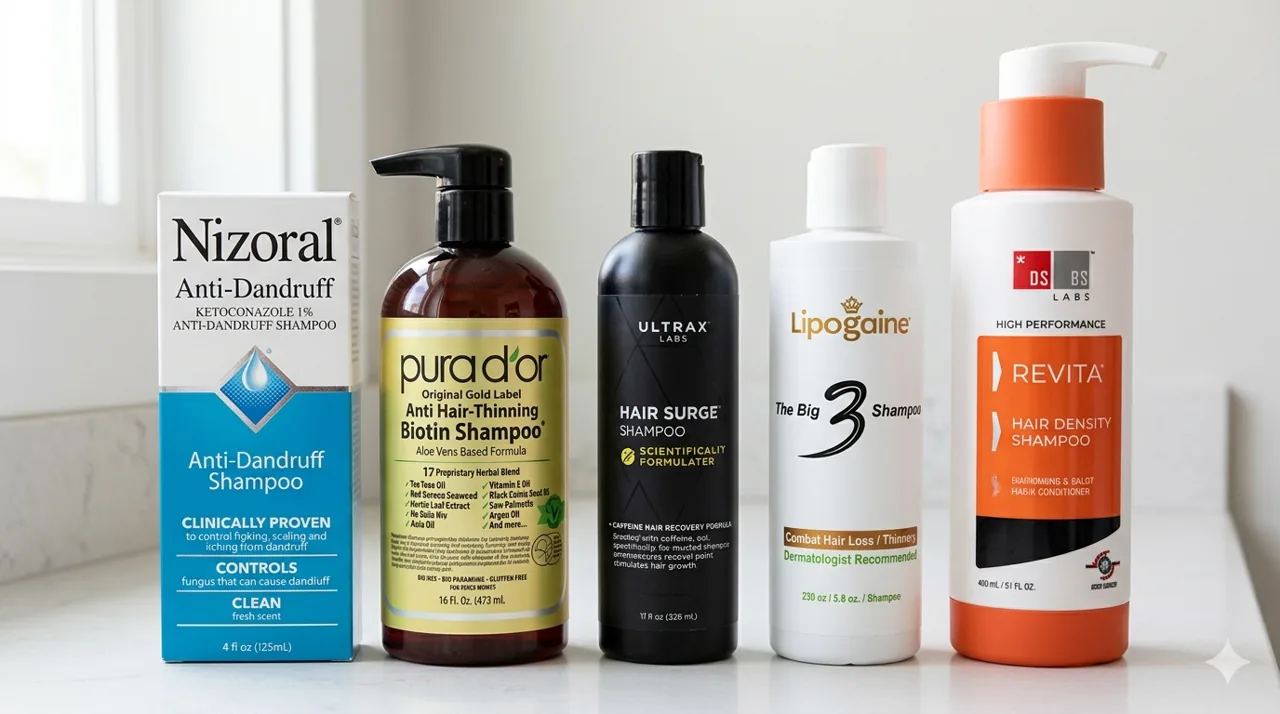
Nizoral A-D Ketoconazole 1% Shampoo
Best For
Men and women with androgenetic alopecia, seborrheic dermatitis
Works In
3+ months (adjunct to primary treatment)
Price
$29.47
as of Sep 14
Pros
- ✓Only DHT shampoo with strong peer-reviewed clinical trial evidence
- ✓Dual benefit: anti-androgenic at follicle + antifungal for scalp health
- ✓OTC availability at most pharmacies (2% prescription available)
- ✓Well-tolerated when used 2-3x per week
Cons
- ✗Can cause scalp dryness with daily use
- ✗1% OTC concentration lower than 2% studied in key trials
- ✗Adjunct only — does not replace primary treatments
- ✗Some users report hair color changes with prolonged use
Pura D'Or Anti-Thinning Biotin Shampoo
Best For
General thinning, users wanting a natural-formula product
Works In
Variable — limited clinical evidence
Price
$39.99
as of Sep 14
Pros
- ✓Popular natural formula with biotin, argan oil, and plant extracts
- ✓Good for scalp hydration and general hair quality
- ✓Large community of satisfied users
- ✓No harsh sulfates
Cons
- ✗No peer-reviewed clinical trial evidence for DHT blockade
- ✗Biotin does not absorb through scalp in useful quantities
- ✗Premium price for ingredient profile with weak DHT evidence
- ✗Not appropriate as a primary hair loss treatment
Ultrax Labs Hair Surge Caffeine Shampoo
Best For
Users interested in caffeine's preliminary mechanism
Works In
Unclear — evidence is mixed
Price
$44.99
as of Sep 14
Pros
- ✓Caffeine has in-vitro evidence for counteracting DHT effects on follicle cells
- ✓Also contains ketoconazole — combined ingredient approach
- ✓Well-formulated, positive user reviews for hair feel
Cons
- ✗No independent peer-reviewed RCT for the specific product
- ✗Caffeine scalp absorption and effective concentration are not established
- ✗High price relative to evidence level
- ✗More expensive than Nizoral for less proven efficacy
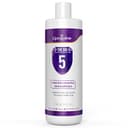
Lipogaine Big 5 Shampoo
Best For
Users wanting a multi-ingredient approach including ketoconazole
Works In
3+ months alongside primary treatment
Price
$30.00
as of Sep 14
Pros
- ✓Contains ketoconazole — the evidence-backed ingredient
- ✓Also includes biotin and saw palmetto for broad coverage
- ✓Designed specifically as a hair loss shampoo
- ✓Reasonable price for the formula
Cons
- ✗Saw palmetto and biotin topical evidence remains weak
- ✗No independent trials on the specific product formulation
- ✗Combining multiple ingredients makes it harder to identify what's working
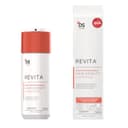
DS Laboratories Revita Shampoo
Best For
Users wanting a premium multi-ingredient shampoo with ketoconazole
Works In
3+ months as adjunct
Price
$36.00
as of Sep 14
Pros
- ✓Contains ketoconazole + caffeine + biotin in a premium formula
- ✓DS Laboratories has some self-funded clinical research
- ✓Well-regarded formula with good user tolerance
- ✓Appeals to users wanting a luxury hair care experience
Cons
- ✗Most expensive option in the ranking
- ✗Evidence for the full formula is largely company-funded
- ✗Premium price not clearly justified by clinical evidence over Nizoral
- ✗Ketoconazole remains the only proven ingredient in the mix
RULE No.11 Anti-Hair Loss Shampoo
Best For
The best-evidenced non-ketoconazole active
Works In
8-12 weeks
Price
$49.99 per 200 mL bottle
Pros
- ✓Piroctone olamine is one of the few non-ketoconazole shampoo actives with its own randomized, placebo-controlled trial for hair shedding
- ✓That trial measured hair count by phototrichogram — an objective count, not a satisfaction survey
- ✓Saw palmetto sits fifth in the ingredient list, a functional position rather than a label decoration
- ✓White willow bark adds mild salicylate exfoliation for scale
Cons
- ✗The piroctone olamine concentration is not published, so it cannot be checked against the 1% used in the research
- ✗Contains cocamide DEA, which California lists under Proposition 65 — most brands reformulated away from it years ago
- ✗Contains fragrance; lower risk in a rinse-off than a leave-on, but worth knowing if your scalp is reactive
- ✗Still a shampoo: no regrowth claim, and it does not replace minoxidil
Piroctone Olamine: The Active Most Guides Miss
Ketoconazole gets the attention, and deservedly — it has the most peer-reviewed evidence of any shampoo ingredient. But it is not the only anti-Malassezia active with real data, and the one most often left out of these guides has better evidence behind it than caffeine, saw palmetto or biotin.
Piroctone olamine works on the same axis as ketoconazole and zinc pyrithione: it suppresses the scalp yeast that drives seborrheic dermatitis, and it also behaves as an antioxidant on the scalp. What makes it worth singling out is that it has been tested directly for hair shedding, not only for dandruff.
A 2021 randomized, double-blind, placebo-controlled study in the International Journal of Cosmetic Science tested a piroctone olamine shampoo and a leave-on treatment against matched placebos over eight weeks, in women with self-perceived thinning. Both produced statistically significant increases in hair amount measured by phototrichogram — an objective hair count, not a satisfaction score or a photo-rated "appearance of density." Markers of scalp oxidative stress fell and scalp barrier readings improved, which is the mechanism the authors propose for the retention effect.
Separately, a head-to-head comparison of 1% ketoconazole, 1% piroctone olamine and 1% zinc pyrithione placed all three in the same frame for hair shedding: in 150 men with dandruff-associated shedding, all three reduced shedding over six months, though hair density itself did not change. Zinc pyrithione also has its own placebo-controlled trial, in which a daily 1% shampoo produced a modest hair-count increase — slightly less than half that of 5% minoxidil. That is the right way to read this category: three routes to one scalp-health mechanism, rather than three unrelated marketing ingredients.
The caveats are real. The eight-week study is industry-affiliated (run by Procter & Gamble), short, and run in women reporting thinning rather than in diagnosed androgenetic alopecia. And the head-to-head research used 1%, a concentration most consumer products — including the one ranked above — do not disclose. Antidandruff shampoos commonly use piroctone olamine below 1%, but whether those lower levels match the shedding results is untested, and undisclosed is still undisclosed.
The practical upshot: if ketoconazole irritates you, or you want to rotate actives, piroctone olamine (or zinc pyrithione) is a substitution with actual evidence behind it. Caffeine and saw palmetto are not.
How to Use DHT Shampoo Effectively
If you're adding ketoconazole shampoo to your regimen, the protocol matters:
Frequency: 2-3 times per week. Not daily — this increases dryness risk without evidence of additional benefit. The ketoconazole studies showing hair improvements used 2-4x weekly protocols.
Contact time: Apply to wet scalp and hair, work into a lather, and leave on for 3-5 minutes before rinsing. Brief contact time reduces efficacy.
Timing relative to minoxidil: If you apply topical minoxidil, use it after shampooing on dry hair — not immediately after the shampoo while the scalp is wet and pores are open. Wait 30-60 minutes after washing.
Expectation setting: Ketoconazole shampoo is an adjunct. The clinical evidence suggests it provides modest follicular support — but the primary treatments in your regimen (finasteride, minoxidil) are doing the heavy lifting.
Our top pick
Nizoral A-D Ketoconazole 1% Shampoo
Ketoconazole is the only DHT-shampoo ingredient with real trial evidence. Use it 2–3 times a week alongside your main treatment.
Sources
- Pierard-Franchimont C et al. Dermatology. 1998. PMID: 9669136
- Hugo Perez BS. Ketocazole as an adjunct to finasteride in the treatment of androgenetic alopecia in men. Med Hypotheses. 2004. PMID: 14729013
- Ketoconazole mechanism: Inui S, Itami S. Reversal of androgenetic alopecia by topical ketoconzole: relevance of anti-androgenic activity. J Dermatol Sci. 2007. PMID: 16997533
- Khandpur S et al. Comparative efficacy of various treatment regimens for androgenetic alopecia in men. J Dermatol. 2002. PMID: 12227482
- Piérard-Franchimont C et al. Nudging hair shedding by antidandruff shampoos: a comparison of 1% ketoconazole, 1% piroctone olamine and 1% zinc pyrithione formulations. Int J Cosmet Sci. 2002. PMID: 18498517
- Davis MG et al. Scalp application of the antioxidant piroctone olamine reduces hair shedding in an 8-week randomized, double-blind, placebo-controlled clinical study. Int J Cosmet Sci. 2021. PMID: 34424549
- Berger RS et al. The effects of minoxidil, 1% pyrithione zinc and a combination of both on hair density: a randomized controlled trial. Br J Dermatol. 2003. PMID: 12932243
- Dhurat R et al. An open-label randomized multicenter study assessing the noninferiority of a caffeine-based topical liquid 0.2% versus minoxidil 5% solution in male androgenetic alopecia. Skin Pharmacol Physiol. 2017. PMID: 29055953
See also: