
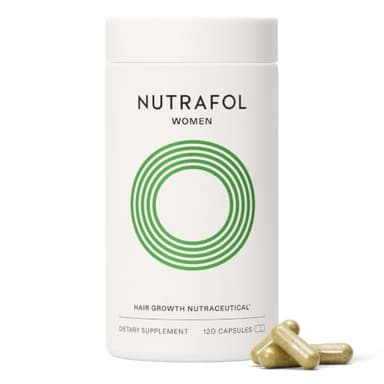
Nutrafol is the best-known hair supplement in the US, and searches for Nutrafol reviews mostly turn up two things: glossy before-and-after photos and affiliate pages that repeat the brand's claims. This review takes a different approach. We read every published trial of the finished products, checked who paid for them, and pulled the side effects that were actually recorded rather than guessed at.
The short version: Nutrafol has more clinical evidence than most hair supplements, but less than its marketing implies, and all of it comes from studies run with the company. Whether it is worth about $88 a month depends on why you are losing hair.
What Nutrafol Is
Nutrafol is a line of dietary supplements made by Nutraceutical Wellness Inc. in New York. Each formula is four capsules a day taken with a meal, and each is built around a patented botanical blend the company calls the Synergen Complex. The main hair formulas are:
- Nutrafol Women (ages 18 to 44). The current version is vegan and biotin-free. Its core blend combines Sensoril ashwagandha, saw palmetto, Moldavian dragonhead, turmeric (curcumin), palm tocotrienols and hyaluronic acid, plus pea sprout extract, a probiotic and vitamins and minerals.
- Nutrafol Men (ages 18 to 49). Saw palmetto, marine collagen, Sensoril ashwagandha, turmeric, tocotrienols and hyaluronic acid, plus keratin, horsetail, resveratrol, black pepper extract and biotin.
- Nutrafol Women's Balance (45 and over). Aimed at perimenopause and menopause. It keeps marine collagen and biotin and adds maca and astaxanthin.
- Nutrafol Postpartum. Drops saw palmetto, ashwagandha and turmeric and uses marine collagen, algae DHA, shatavari, L-theanine and a fuller set of B vitamins. Nutrafol markets it as breastfeeding-friendly.
The labels list every ingredient but not the dose of each one inside the blends. For the full ingredient lists and the evidence behind each ingredient, see our Nutrafol ingredients breakdown.
Does Nutrafol Work? What the Trials Show
Nutrafol has published eight studies of its finished products. Only three compared Nutrafol against a placebo, which is the design that can actually separate the supplement's effect from the passage of time and the expectation of improvement. The rest followed people taking Nutrafol with no comparison group.
| Study | Formula | Design | n | Duration | Key outcome | Funding / affiliation | PMID |
|---|---|---|---|---|---|---|---|
| Ablon & Kogan, 2018 | Women (earlier formula) | Double-blind RCT vs placebo | 40 (26 active, 14 placebo) | 6 months | More terminal and vellus hairs than placebo at 90 and 180 days; no adverse events reported | Not stated in abstract; Kogan is listed as a company employee in a 2022 paper | 29742189 |
| Ablon & Kogan, 2021 | Women's Balance | Double-blind RCT vs placebo | 70 (40 active, 30 placebo) | 6 months | More terminal and total hairs than placebo; shedding down 32.41% by day 180 | Not stated in abstract | 33400421 |
| Ablon et al., 2022 | Women's Balance | Open-label extension of the 2021 trial | Not given in abstract | 6 more months | Continued gains; former placebo group improved once switched | Not stated in abstract | 35816069 |
| Bhatia et al., 2025 | Men | Double-blind RCT vs placebo | 112 enrolled, 85 completed (52 active, 33 placebo) | 6 months | Investigators rated growth improved in 79% on Nutrafol vs 51% on placebo at day 180; no change in sexual function | Funded by Nutraceutical Wellness | 39757794 |
| Stephens et al., 2022 | Men or Women | Single-blind, no placebo | 98 (47 men, 51 women) | 6 months | Investigator-rated improvement in 83.7% of men and 79.5% of women | Four of five authors company employees | 35309272 |
| Sivamani et al., 2024 | Women's Vegan | Single-blind, no placebo | 95 completed | 6 months | More terminal hairs than at baseline | Not stated in abstract; co-authors Hazan and Raymond are company employees | 39093662 |
| Draelos et al., 2026 | Women, Vegan, Balance, Postpartum, Men | Open-label, no placebo | 252 enrolled, 244 completed | 6 months | Thicker hair shafts and less breakage than at baseline | Funded by Nutraceutical Wellness | 41171588 |
| Dang et al., 2026 | Four women's formulas | Open-label, no placebo | 180 enrolled, 150 completed | 6 months | Faster hair growth rate than at baseline at 90 and 180 days | Funded by Nutraceutical Wellness | 42449043 |
What this adds up to. The three placebo-controlled trials point the same way: people taking Nutrafol did better than people taking a dummy capsule. That is more than most hair supplements can show. But the trials are small (40, 70 and 85 completers), the men's trial lost about a quarter of its participants, and every study involved company funding, company employees or both. The open-label studies, which make up most of the larger numbers, cannot tell you how much improvement came from the supplement rather than from placebo or seasonal change.
Independent reviewers land in the same place. A 2023 JAMA Dermatology systematic review by Harvard- and Tufts-affiliated authors listed Nutrafol among the supplements with the highest-quality evidence of potential benefit, alongside Viviscal and others, and called for larger trials against active treatments PMID: 36449274. A 2026 meta-analysis of commercial hair supplements, with authors declaring no conflicts, found promising preliminary results but concluded that more rigorous, independent research is needed PMID: 41954038.
One more gap matters for women. The 2018 placebo-controlled trial tested an earlier version of Nutrafol Women. We found no published placebo-controlled trial of the current vegan, biotin-free formula, only the open-label studies above.
How Long Does Nutrafol Take to Work?
Nutrafol's own product pages say results take three to six months, and that matches how the trials were run. Every study measured hair at 90 and 180 days. The two placebo-controlled trials in women reported gains over placebo at both points; in the men's trial, the difference from placebo in investigator-rated growth was significant at day 180. In the men's trial, the share of men rated improved on Nutrafol rose from 57% at day 90 to 79% at day 180, while the placebo group stayed close to 50%.
That timeline reflects the hair growth cycle rather than anything special about Nutrafol. Hair grows slowly, and shedding that has already been triggered takes months to settle. A fair test is six months of daily use, with photos taken at the start in the same light. If nothing has changed by then, more months are unlikely to help.
Nutrafol Side Effects and Safety
Here is what the trials and the safety literature actually record, by formula.
Nutrafol Women. The 2018 trial reported no adverse events. In the 2026 study of four women's formulas, 29 side effects were judged possibly or probably related to the products, 28 of them mild. The most common were stomach upset (12 people) and acne (8 people), and 9 participants (5%) withdrew because of side effects. One serious event, Hashimoto's thyroiditis, occurred in the group taking the formula the paper calls Women Advanced and was rated possibly related PMID: 42449043. In the 2026 hair-thickness study, two women on the vegan formula stopped because of nausea and vomiting in one case and acne in the other; both resolved after stopping PMID: 41171588.
Nutrafol Men. In the placebo-controlled trial, eight possibly or probably related side effects occurred in six men, three on Nutrafol and three on placebo, all stomach-related (bloating, irritable stomach, diarrhea and intermittent nausea). One man in each group withdrew. Scores on a standard sexual function questionnaire did not change, which matters because men often ask whether the saw palmetto behaves like finasteride PMID: 39757794.
Women's Balance. The 2021 trial describes the supplement as well tolerated PMID: 33400421.
Postpartum. Postpartum has no placebo-controlled trial of its own. It was one of the groups in the two 2026 open-label studies, where the side effects reported were mild. Nutrafol calls it breastfeeding-friendly, but none of the postpartum supplements we rank has published safety studies in nursing mothers, so check with your doctor or lactation consultant first. Our postpartum supplement guide covers the options.
Does Nutrafol cause weight gain? We found no evidence either way. None of the trial abstracts lists weight gain, the full texts of the men's trial and both 2026 studies do not mention it, and Nutrafol's product pages do not mention it. Equally, the trials did not report measuring weight, so they cannot rule it out. If you notice a change, stop and see whether it reverses.
Ingredient-level risks. These are rare but worth knowing:
- Liver. Ashwagandha (in Women, Men and Women's Balance) has been linked to uncommon, often cholestatic liver injury. A 2026 scoping review found 25 published cases; most people recovered after stopping, and the authors advise people with advanced chronic liver disease to avoid it PMID: 42367407, PMID: 31643854. Turmeric has also been implicated: the US Drug-Induced Liver Injury Network described 10 cases, typically 1 to 4 months after starting, and 3 of the 7 products tested also contained black pepper (piperine) PMID: 36252717. Nutrafol Men and Women's Balance contain both turmeric and black pepper extract. Stop and see a doctor if you develop yellowing skin, dark urine or itching.
- Blood tests. Biotin can distort some lab tests. In a JAMA study, six healthy adults took 10 mg a day for a week, and 9 of 23 biotin-based assays gave distorted results, in a panel that included thyroid tests PMID: 28973622. The current Women formula no longer contains biotin, but Men, Women's Balance and Postpartum do, and the labels do not say how much. Tell whoever orders your blood work.
- Other ashwagandha cautions. The NIH LactMed database advises caution with ashwagandha in people with diabetes, high blood pressure or hormone-sensitive prostate cancer, and advises avoiding it while breastfeeding because there is no published experience PMID: 30000965.
- Medications. Nutrafol itself advises consulting a physician if you take medications, "especially anticoagulant and blood-thinning drugs."
Who Should Avoid Nutrafol
- Pregnant women and those trying to conceive. Nutrafol recommends skipping all formulas.
- Breastfeeding mothers, except for the Postpartum formula, and then only after checking with a doctor. Women, Men and Women's Balance contain ashwagandha.
- Anyone under 18. Nutrafol does not recommend it for this age group.
- People with liver disease, or anyone who has had a reaction to ashwagandha or turmeric.
- People on blood thinners or other regular medication, until they have checked with a doctor.
- Men already taking finasteride or dutasteride, who should discuss the saw palmetto with their prescriber.
- People with a fish allergy, who should check the label of Men, Women's Balance and Postpartum, which contain marine collagen.
Is Nutrafol Legit? Price, Subscription and Refunds
Nutrafol is a real company with peer-reviewed, registered trials, so it is legitimate in that sense. It is also a dietary supplement, not a medicine: the FDA does not have the authority to approve dietary supplements before they are sold, and Nutrafol's own site states that its claims have not been evaluated by the FDA.
It costs about $88 a month for the core formulas, and Nutrafol sells mainly by subscription. Under its Terms of Use (last updated September 23, 2026), subscriptions renew automatically. You can cancel from your account page at any time before the next period starts, but you will not be refunded for the period you are in. The same terms offer a full refund or exchange on a returned product within 30 days of delivery, if it is in its original condition and packaging.
Nutrafol also runs a "Real Growth Guarantee" (terms effective June 5, 2026). The conditions are strict. You must be a first-time subscriber buying on nutrafol.com, buy at least six bottles by subscription within 180 days, keep the subscription active, complete check-ins and submit progress photos in the myNutrafol app, and file your claim between days 180 and 210. Purchases from Amazon or other retailers do not qualify. Read the terms before counting on it.
Is Nutrafol Worth It?
Our ratings. We rate Nutrafol Women 4.0 out of 5, in line with our best hair supplements for women ranking. In other categories we rank Nutrafol Men at 4.6 in our men's supplement ranking and Nutrafol Postpartum at 4.8 in our postpartum ranking. Those scores compare each formula with the alternatives in its own category, not with prescription treatment.
Nutrafol vs Viviscal. Viviscal also has small, manufacturer-linked placebo-controlled trials, works through a marine protein complex rather than botanicals, and costs roughly half as much. For diffuse thinning without an obvious stress or hormonal trigger, it is the better-value starting point. Viviscal is not suitable for people with fish or shellfish allergies, and Nutrafol Women is the vegan option. See our Nutrafol vs Viviscal comparison and our Nutrafol alternatives ranking.
Nutrafol vs minoxidil and finasteride. For pattern hair loss (a widening part, a thinning crown or a receding hairline), no supplement matches these. Minoxidil is FDA-approved for men and women and costs a fraction of Nutrafol; see our best minoxidil guide. For men, finasteride blocks DHT far more strongly than saw palmetto: in a two-year comparison, 68% of men improved on finasteride vs 38% on saw palmetto PMID: 23298508. Nutrafol can sit alongside these treatments, but it should not replace them.
Nutrafol is a reasonable choice if your shedding seems linked to stress, menopause or a recent life change, you have had blood tests to rule out low iron and thyroid problems, you want a non-prescription option, and you can afford six months to test it properly. It is a poor choice if you have clear pattern hair loss and are not using minoxidil or finasteride, or if $88 a month would stop you affording a treatment with stronger evidence.
Our Verdict
Nutrafol works modestly. Three placebo-controlled trials, in women, menopausal women and men, found more hair growth than placebo over six months, which puts it near the top of the supplement category. Those trials are small and all connected to the company, the current Women formula has not been tested against placebo, and the effect sizes are nowhere near what minoxidil or finasteride deliver. Side effects in the trials were mostly mild stomach upset, but the ashwagandha and turmeric carry rare liver risks, and most formulas are off-limits in pregnancy and while nursing.
We rate Nutrafol Women 4.0 out of 5: a credible supplement for stress- or hormone-linked thinning, best used alongside proven treatment rather than instead of it, and expensive for evidence of this size. If cost is the deciding factor, Viviscal offers a similar evidence base for about half the price.
Sources
- Ablon G, Kogan S. A six-month, randomized, double-blind, placebo-controlled study evaluating the safety and efficacy of a nutraceutical supplement for promoting hair growth in women with self-perceived thinning hair. Journal of Drugs in Dermatology. 2018;17(5):558-565. PMID: 29742189.
- Ablon G, Kogan S. A randomized, double-blind, placebo-controlled study of a nutraceutical supplement for promoting hair growth in perimenopausal, menopausal, and postmenopausal women with thinning hair. Journal of Drugs in Dermatology. 2021;20(1):55-61. PMID: 33400421.
- Ablon G, Kogan S, Raymond I. A long-term study of the safety and efficacy of a nutraceutical supplement for promoting hair growth in perimenopausal, menopausal, and postmenopausal women. Journal of Drugs in Dermatology. 2022;21(7):776-783. PMID: 35816069.
- Bhatia N, Ablon G, Farris PK, Hazan A, Raymond I. A randomized, double-blind, placebo-controlled study to evaluate the safety and efficacy of a nutraceutical supplement with standardized botanicals in males with thinning hair. Journal of Cosmetic Dermatology. 2025;24(1):e16778. PMID: 39757794.
- Stephens TJ, Berkowitz S, Marshall T, Kogan S, Raymond I. A prospective six-month single-blind study evaluating changes in hair growth and quality using a nutraceutical supplement in men and women of diverse ethnicities. Journal of Clinical and Aesthetic Dermatology. 2022;15(1):21-26. PMID: 35309272.
- Sivamani RK, Ablon G, Nong Y, et al. A prospective, multi-center study to evaluate the safety and efficacy of a vegan nutraceutical to improve hair growth and quality in females following a plant-based diet. Journal of Drugs in Dermatology. 2024;23(8):661-668. PMID: 39093662.
- Draelos Z, Farris PK, Hazan A, Raymond I. A 6-month, prospective, multi-arm study for the efficacy of standardized nutraceuticals to improve hair fiber thickness and strength. Dermatology and Therapy. 2026;16(1):353-363. PMID: 41171588.
- Dang R, Sivamani RK, Hazan A, Raymond I. A 6-month prospective, open-label, randomized study showing increased hair growth rate in women using multi-targeting hair growth nutraceuticals. Dermatology and Therapy. 2026;16(9):4419-4432. PMID: 42449043.
- Drake L, Reyes-Hadsall S, Martinez J, et al. Evaluation of the safety and effectiveness of nutritional supplements for treating hair loss: a systematic review. JAMA Dermatology. 2023;159(1):79-86. PMID: 36449274.
- Alanazi R, Alshammari S, Aldossari K, et al. Evaluating the effectiveness of commercial oral supplements for hair growth: a systematic review and meta-analysis. Journal of Cosmetic Dermatology. 2026;25(4):e70817. PMID: 41954038.
- Rossi A, Mari E, Scarno M, et al. Comparative effectiveness of finasteride vs Serenoa repens in male androgenetic alopecia: a two-year study. International Journal of Immunopathology and Pharmacology. 2012;25(4):1167-1173. PMID: 23298508.
- McIntyre D, Nguyen P, Kim Y, Meyer B, Salloum M. Ashwagandha (Withania somnifera)-associated liver injury: a scoping review of clinical characteristics and safety considerations. Cureus. 2026;18(5):e109764. PMID: 42367407.
- LiverTox. Ashwagandha. National Institute of Diabetes and Digestive and Kidney Diseases; updated 2024. PMID: 31643854.
- Halegoua-DeMarzio D, Navarro V, Ahmad J, et al. Liver injury associated with turmeric: a growing problem. Ten cases from the Drug-Induced Liver Injury Network (DILIN). American Journal of Medicine. 2023;136(2):200-206. PMID: 36252717.
- Li D, Radulescu A, Shrestha RT, et al. Association of biotin ingestion with performance of hormone and nonhormone assays in healthy adults. JAMA. 2017;318(12):1150-1160. PMID: 28973622.
- Drugs and Lactation Database (LactMed). Withania. National Institute of Child Health and Human Development; updated 2024. PMID: 30000965.
- U.S. Food and Drug Administration. Questions and Answers on Dietary Supplements, accessed October 18, 2026.
- Nutrafol product pages and FAQs for Women, Men, Women's Balance and Postpartum; Terms of Use (last updated September 23, 2026); Real Growth Guarantee terms (effective June 5, 2026). All accessed October 18, 2026.
See also: