Let's be honest about the postpartum supplement market: it is enormous, it is aggressively marketed, and most products lack meaningful clinical evidence. But some do have evidence — and since postpartum hair loss is a real, distressing experience that affects up to half of all new mothers, it's worth knowing which ones.
We evaluated these supplements on five criteria:
- Clinical evidence — are there actual peer-reviewed trials, ideally randomized and controlled?
- Ingredient quality and relevance — do the ingredients address the specific biology of postpartum telogen effluvium?
- Breastfeeding safety — a non-negotiable for many of the women who need this category
- Value — is the price justified by what you get?
- Real-world outcomes — what do verified purchasers actually report?
Quick Answer
Nutrafol Postpartum leads the category as the only major supplement formulated specifically for postpartum shedding, backed by the brand's broader clinical research (though not a postpartum-specific placebo-controlled trial). Viviscal is the best-evidenced alternative. Baby Blues is the most affordable postpartum-specific option. Your prenatal vitamin is the foundation that everything else builds on.
Our Rankings
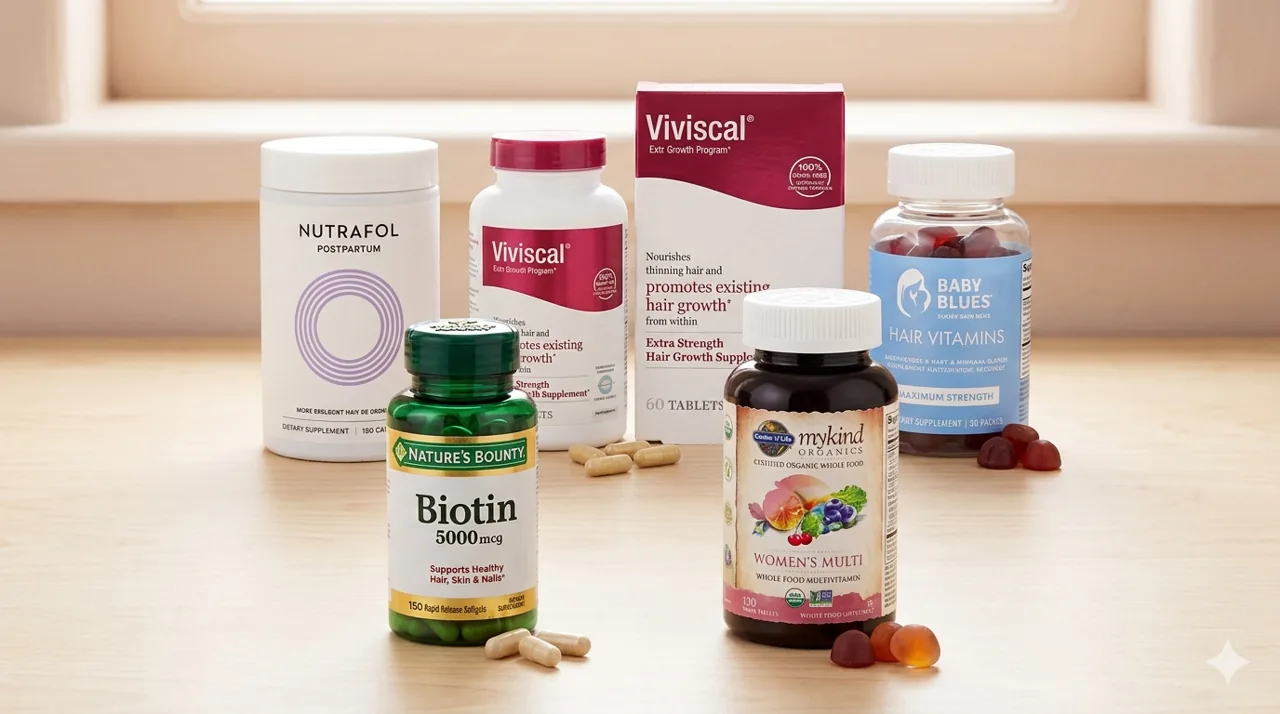
Nutrafol Postpartum
Best For
Postpartum shedding
Works In
3-6 months
Price
$88/mo
Pros
- ✓Only major supplement formulated specifically for postpartum shedding
- ✓From the brand with the most published hair-growth research (incl. placebo-controlled RCTs in its other formulas)
- ✓Safe for breastfeeding
- ✓Addresses cortisol and hormonal stress alongside nutrition
Cons
- ✗Postpartum benefit is extrapolated — no placebo-controlled trial in postpartum women specifically
- ✗Most expensive option at $88/month
- ✗Takes 3-6 months for full results
- ✗Subscription model with cancellation friction
We earn 4%/sale if you sign up · See all commissions
Viviscal Extra Strength
Best For
Diffuse thinning
Works In
3-6 months
Price
$40/mo
Pros
- ✓More clinical evidence than any other hair supplement brand
- ✓Marine collagen complex well-studied
- ✓Affordable compared to Nutrafol
- ✓Widely available
Cons
- ✗Not specifically designed for postpartum
- ✗Contains shellfish (not suitable for fish/shellfish allergies)
- ✗Marine protein smell is noticeable
We earn 4%/sale if you sign up · See all commissions
Baby Blues Hair Vitamins
Best For
Postpartum on a budget
Works In
2-4 months
Price
$25/mo
Pros
- ✓Specifically designed for postpartum mothers
- ✓Contains DHA — important for breastfeeding mothers
- ✓Most affordable postpartum-focused option
- ✓No subscription required
Cons
- ✗Less clinical data than Nutrafol or Viviscal
- ✗Smaller company with less third-party testing transparency
- ✗Newer brand with shorter track record
We earn 4%/sale if you sign up · See all commissions
Nature's Bounty Biotin 5000mcg
Best For
Adding to an existing prenatal
Works In
Varies
Price
$12/mo
Pros
- ✓Very affordable — under $15/month
- ✓Widely available in pharmacies
- ✓Reputable brand with NSF certification available
- ✓Good option if biotin is not in your prenatal
Cons
- ✗Biotin alone has limited evidence for telogen effluvium
- ✗Not a comprehensive postpartum formula
- ✗High-dose biotin can interfere with thyroid lab tests
We earn 4%/sale if you sign up · See all commissions
Garden of Life Women's Once Daily
Best For
Whole-food multivitamin approach
Works In
3-6 months
Price
$35/mo
Pros
- ✓Whole food-sourced nutrients with better bioavailability in some cases
- ✓USDA certified organic
- ✓Covers broad nutritional base including iron and B vitamins
- ✓Good for women who prefer clean-label supplements
Cons
- ✗Not hair-specific — no marine collagen or adaptogens
- ✗No clinical trials for hair loss
- ✗Folate dose may be insufficient for breastfeeding needs
We earn 4%/sale if you sign up · See all commissions
What Should You Look for in a Postpartum Hair Supplement?
Iron: The Most Important Nutrient You're Probably Not Getting Enough Of
Iron deficiency is epidemic postpartum. Blood loss during delivery depletes iron stores, and breastfeeding increases demand further. Low ferritin (the stored form of iron) is independently associated with telogen effluvium — meaning iron deficiency can cause or worsen hair loss on its own, separate from the estrogen drop.
Most "hair supplements" do not contain iron because iron is tricky to formulate (it reacts with other compounds and can cause GI upset at higher doses). This is why we recommend checking whether your prenatal vitamin contains iron and continuing it postpartum. If your ferritin is below 40 ng/mL (some researchers argue below 70 ng/mL), iron supplementation may be the single most effective thing you can do for postpartum hair loss.
Bottom line: Check your ferritin. Address deficiency with your doctor's guidance. Do not rely on a "hair supplement" to cover iron needs.
Biotin: More Is Not Better
Every postpartum hair supplement contains biotin, and for good reason — biotin deficiency causes brittle hair and nails, and pregnancy can deplete it. But the supplement marketing has gotten ahead of the evidence.
If you're already taking a prenatal with 30mcg of biotin, you are almost certainly not deficient. High-dose supplementation (5,000-10,000mcg) above adequacy levels has not been shown in clinical trials to improve postpartum hair loss specifically.
There's one practical caution: high-dose biotin can interfere with certain thyroid hormone and cardiac enzyme lab tests, giving falsely normal or falsely abnormal results. Tell your doctor if you're taking high-dose biotin before any lab work.
A standard 1,000-2,500mcg dose covering the daily adequate intake is sensible. Megadosing is not.
Omega-3 Fatty Acids (DHA and EPA): Underrated
Omega-3s are often present in fish oil or DHA supplements. They have genuine evidence for supporting hair density — a 6-month randomized trial in the Journal of Cosmetic Dermatology showed significantly increased hair density and reduced telogen hairs in women taking omega-3 and omega-6 fatty acids with antioxidants.
For breastfeeding mothers, there is a double reason: DHA supplementation during nursing supports infant brain development and may reduce the DHA depletion that occurs in mothers providing it through breast milk. Baby Blues Vitamins specifically includes DHA, which is a legitimate differentiator.
Marine Collagen: The Viviscal Edge
Viviscal's proprietary AminoMar marine protein complex is one of the best-evidenced ingredients in the hair supplement space. Multiple randomized controlled trials have shown meaningful improvements in hair count and thickness.
The mechanism is plausible: marine proteins provide amino acids used in keratin production, and the specific combination in AminoMar appears to support follicle activity. It is not magic, but it has earned its place in the evidence hierarchy.
Adaptogens: Why Nutrafol Added Ashwagandha
Postpartum life is physiologically stressful in ways that extend beyond the estrogen drop. Elevated cortisol (the stress hormone) is a documented contributor to telogen effluvium — high cortisol can push follicles into the resting phase prematurely.
Ashwagandha (withania somnifera) has genuine evidence for reducing cortisol levels in stressed adults. Nutrafol's inclusion of ashwagandha extract is not marketing fluff — it addresses a real physiological pathway. Whether the dose used is optimal is harder to assess, but the intent and mechanism are sound.
Breastfeeding Safety
Every supplement on our list has been evaluated for breastfeeding safety. A few notes:
- Saw palmetto — frequently found in "hair supplements" marketed to men, but increasingly appearing in women's formulas — is not recommended during breastfeeding due to insufficient safety data and potential hormonal effects. Nutrafol Postpartum specifically reformulated away from saw palmetto compared to their standard formula.
- High-dose vitamin A (retinol, not beta-carotene) can be harmful at excess levels while breastfeeding. Check that any supplement you take stays within tolerable upper limits.
- Iron at high doses can cause GI issues — use the lowest effective dose.
When in doubt, run the ingredient list by your OB or midwife. This is not overcaution; it is appropriate for anything entering breast milk.
The Supplement Protocol We'd Recommend
For a new mother navigating postpartum hair loss, our honest suggestion:
Minimum effective approach (budget-friendly):
- Continue a quality prenatal with iron
- Add an omega-3/DHA supplement if not in your prenatal
- Get your ferritin checked; supplement iron if low
If you want to do more:
- Add Nutrafol Postpartum or Viviscal on top of the above
- Be patient — the timeline is 3-6 months before seeing meaningful change
Skip:
- Biotin megadoses without confirmed deficiency
- Products containing saw palmetto
- Anything promising "rapid regrowth in weeks" — this is not biologically possible
What Is the Honest Timeline for Results?
No supplement can shortcut the biological timeline of postpartum hair recovery. The estrogen-driven shedding phase has its own schedule. What supplementation can do is ensure your body has everything it needs to regrow hair efficiently once the shedding phase ends — and potentially reduce the severity of shedding by addressing nutritional deficiencies.
Expect to start a supplement at 2-3 months postpartum (when shedding typically begins) and evaluate at 6 months. If you started late, give it a full 4-6 months before drawing conclusions.
For most women, the hair returns on its own by 12 months postpartum regardless of supplementation. The question is whether you want to support the process more actively — and whether the cost fits your circumstances.
If you want to understand the full picture of postpartum hair loss, including why it happens and when to see a doctor, read our guide: Hair Loss After Baby: What's Normal and What Actually Helps.
Our top pick
Nutrafol Postpartum
The only supplement designed specifically for the postpartum shed — our top pick for new mothers, if the $88/month fits your budget.
We earn 4%/sale if you sign up · See all commissions
Sources
- Ablon G. A 3-month, randomized, double-blind, placebo-controlled study evaluating the ability of an extra-strength marine protein supplement to promote hair growth and decrease shedding in women with self-perceived thinning hair. Dermatology Research and Practice. 2015;2015:841570. PMID: 25883641.
- Glynis A. A double-blind, placebo-controlled study evaluating the efficacy of an oral supplement in women with self-perceived thinning hair. Journal of Clinical and Aesthetic Dermatology. 2012;5(11):28-34. PMID: 23198010.
- Grover C, Khurana A. Telogen effluvium. Indian Journal of Dermatology, Venereology and Leprology. 2013;79(5):591-603. PMID: 23974577. (Mechanism and natural history of postpartum telogen effluvium.)
- Trost LB, Bergfeld WF, Calogeras E. The diagnosis and treatment of iron deficiency and its potential relationship to hair loss. Journal of the American Academy of Dermatology. 2006;54(5):824-844. PMID: 16635664.
- Le Floc'h C, Cheniti A, Connétable S, et al. Effect of a nutritional supplement on hair loss in women. Journal of Cosmetic Dermatology. 2015;14(1):76-82. PMID: 25573272.
- Guo EL, Katta R. Diet and hair loss: effects of nutrient deficiency and supplement use. Dermatology Practical & Conceptual. 2017;7(1):1-10. PMID: 28243487.
- A 6-Month Prospective, Open-Label, Randomized Study Showing Increased Hair Growth Rate in Women Using Multi-Targeting Hair Growth Nutraceuticals. Dermatology and Therapy. 2026. doi:10.1007/s13555-026-01866-z. [Note: open-label (not placebo-controlled), industry-funded; life-stage formulas including postpartum were evaluated in a general female population (18–70), not in postpartum women specifically.]
We earn commissions on some supplement links on this page. Our methodology page discloses exactly what we earn from each partner. Commission rates do not influence our rankings — Nutrafol ranks first because it has the most evidence, not because we earn more from it.