
Most hair supplement ingredients arrive with a mechanism and no outcome. Something inhibits 5α-reductase in a dish, or supports keratin synthesis in theory, and that becomes the marketing. Actual randomized human trials measuring whether hair improved are rare.
Spermidine and wheat-derived ceramides are the uncommon exception. Both have placebo-controlled human studies reporting real shifts in hair cycling. That deserves a straight look — including at where the evidence stops.
Spermidine: The Anagen Trial
Spermidine is a polyamine — a small molecule your cells make and that also appears in wheat germ, aged cheese, and soy. Polyamines regulate cell proliferation, and hair follicles are among the fastest-proliferating tissues in the body, which is the mechanistic reason anyone looked at this in the first place.
The study people cite is Rinaldi and colleagues, 2017, published in Dermatology Practical & Conceptual. One hundred healthy men and women were randomized to a spermidine-based supplement or placebo, once daily, double-blind, for 90 days.
What they found:
- More anagen V–VI follicles in the spermidine group at three months — meaning a greater share of hairs in the active growing phase
- Higher Ki-67, a marker of cell proliferation, in treated follicles
- Lower c-Kit, a marker of apoptosis
- Pull test negative in all treated patients at six months, versus 68% positive in the placebo group
All significant against placebo. By supplement-industry standards that is an unusually clean result — a real randomization, a real placebo arm, and biological markers rather than only self-reported satisfaction.
Two honest qualifications. It is a single study of 100 people over three months, and the authors themselves call it preliminary. And it tested a specific spermidine-based formulation at a specific dose — which is not automatically what any given capsule on Amazon contains.
Ceramides: The Wheat Polar Lipid Trial
Ceramides are lipids that help form the skin's barrier. The hair-focused version is usually Ceramosides, a branded wheat polar lipid complex, and it also has randomized placebo-controlled data — published in the International Journal of Cosmetic Science.
Reported results at 12 weeks against placebo:
- ~23% reduction in telogen (resting/shedding-phase) hair
- ~12% increase in anagen hair
- Reduced shedding on pull testing, with separation from placebo emerging by around 56 days
Same direction as the spermidine work: a shift in the ratio of growing to resting hairs, and less fallout.
The qualification here is sponsorship. This research comes from Seppic, the company that makes and sells Ceramosides. Manufacturer-funded trials are not automatically wrong — plenty of good science is industry-funded — but the effect sizes in sponsored nutraceutical research tend to shrink when independent groups repeat them, and that independent replication has not really happened yet.
What These Results Do and Do Not Mean
Both trials measured essentially the same thing: the proportion of hairs in the growing phase, and how much you shed. That is a genuine, measurable outcome, and it is the outcome most relevant to diffuse thinning and excess shedding.
It is not the same as regrowth. Neither study demonstrates that miniaturized follicles were restored, or that a receding hairline advanced back. Shifting the anagen-to-telogen ratio means you keep more of the hair you currently have and cycle it more favourably. That is worth something. It is a smaller claim than "hair growth accelerator" implies.
And there is a structural gap that applies to nearly every product built on these ingredients: the trials tested ingredients, not the products now selling them. This is the same standard we apply everywhere else on this site. Viviscal and Nutrafol get credit specifically because their own finished formulas were put through randomized trials. A capsule containing spermidine among twenty-nine other things has borrowed the credential rather than earned it — unless the brand publishes its dose and that dose matches what was tested.
When a label says "clinically validated formula," the question worth asking is: validated as a formula, or validated as an ingredient somebody else studied?
Where These Sit Against Real Treatments
For androgenetic hair loss — the receding temples and thinning crown that bring most people here — minoxidil and finasteride remain the treatments with strong regrowth evidence, and nothing in this article changes that. Spermidine and ceramides are not alternatives to them.
Where they plausibly fit:
- Diffuse shedding and thinning, especially where the pull test is positive — the outcome both trials actually measured
- Alongside minoxidil rather than instead of it
- As a supplement choice if you were going to take one anyway — these ingredients have more behind them than biotin, which does nothing unless you are deficient, or the botanical blends common in DHT-blocking products
If you are choosing purely on strength of evidence, Viviscal still has the advantage of trials on the actual product. If you want the newer ingredients with real data behind them, this is a defensible place to spend.
A Product Using Both
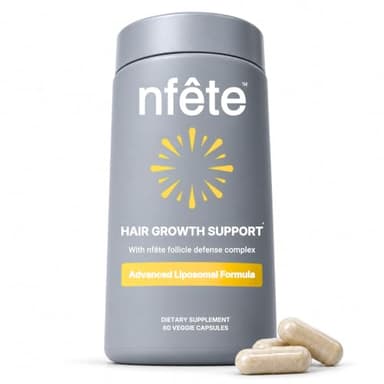
nfête Hair Growth Supplements is the product that prompted this piece — 29 liposomal hair vitamins, two capsules daily, built around Ceramosides and spermidine.
On ingredient selection it is the strongest supplement we have looked at recently. Choosing spermidine and Ceramosides over the usual biotin-and-botanicals stack means choosing the two ingredients in this space that actually have placebo-controlled hair trials. That is a real point in its favour.
The limits are the ones already described, and they are not small. The listing does not publish how much spermidine or Ceramosides each capsule contains, so there is no way to check it against the trial doses — and the trials are the entire basis of the claim. "Clinically validated formula" is doing exactly the work described above: the ingredients have been studied, this formula has not. With 29 ingredients in the mix, the odds that each is present at a studied dose are not favourable.
Our grade: promising ingredients, unverified formula. Reasonable to try if you want the newer evidence-backed compounds and accept that you are buying on ingredient data rather than product data. If you want a supplement whose actual formula was trialled, Viviscal remains the safer pick.
The Bottom Line
Spermidine and wheat ceramides are the rare supplement ingredients that showed up to a randomized trial and produced a result. That earns them a genuine hearing, and it puts them well ahead of the botanical blends and biotin megadoses that dominate the shelf.
Keep the claim the right size. The evidence is for more hairs in the growing phase and less shedding, over three months, in small studies, one of them manufacturer-funded — not for regrowing a hairline. And until brands publish doses, you are trusting that the capsule matches the study.
If you have pattern hair loss, start with the treatments that regrow hair. If you shed heavily and want a supplement with something real behind it, this is a better-reasoned bet than most of the aisle.