
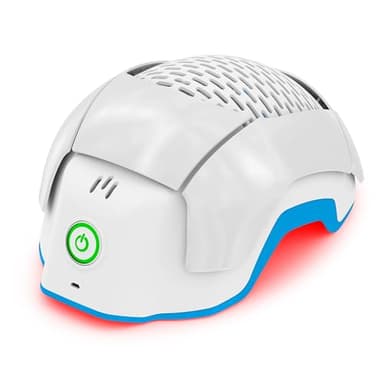
Both the Theradome PRO LH80 and the iRestore Elite are full-scalp laser helmets — same form factor, very different philosophies. Theradome sells laser purity; iRestore sells raw source count. Here's the FDA-verified comparison, including the number that cuts through both marketing angles.
Head to Head
| Theradome PRO LH80 | iRestore Elite | |
|---|---|---|
| Price (brand-direct) | ~$995 | ~$1,799 |
| Light sources | 80 lasers — 100% laser, no LEDs | 500 = 300 lasers + 200 LEDs |
| Wavelength | 678–680 nm | 680 nm (lasers) + 625/655 nm (LEDs) |
| Total output | Not published (727 J/treatment stated) | 2,500 mW per session |
| Coverage | Full scalp | Full scalp |
| Session | 20 min, 2×/week | 12 min, 3×/week |
| Cordless | Yes (~15 oz) | Corded unless optional battery |
| FDA clearance | Cleared — K171775 (2018) | Cleared — K222081 (2022) |
| Device-specific published RCT | None (ran own sham trial, unpublished) | None (in-house study on older ID-500) |
| Money-back guarantee | 6 mo (12 via quiz); 25% fee | 12 months |
| Evidence grade | Limited | Limited |
The Number That Cuts Through the Marketing
Both brands lead with a laser claim, and they pull in opposite directions:
- Theradome: "100% lasers, no LEDs." True — all 80 of its sources are laser diodes.
- iRestore: "500 lights." Also (partly) true — but that's 300 laser diodes + 200 LEDs, not 500 lasers.
Here's the catch that neither ad makes obvious: iRestore actually has more laser diodes than Theradome — 300 vs 80 — and 200 LEDs on top. So "all-laser" (Theradome) is not the same as "more lasers" (iRestore). On published output, iRestore's 2,500 mW is the higher figure; Theradome doesn't publish a total (its edge is purity, not quantity). Since neither helmet has a published trial proving its dose regrows more hair, treat this as a philosophy difference, not a settled performance gap.
Where Theradome Wins
- Price — roughly $800 less than the iRestore Elite.
- Cordless as standard (iRestore is corded unless you buy the battery), and lighter (~15 oz).
- Fewer sessions — 2×/week vs 3×/week.
- All-laser construction — no LEDs padding the count.
- It tested the actual device. Theradome ran a randomized, sham-controlled trial on the LH80 itself (though unpublished) — whereas iRestore's efficacy figures come from a study on its older ID-500, not the Elite. A modest but real edge in relevance. Full detail in the Theradome PRO LH80 review.
Where iRestore Wins
- More laser diodes and higher published output — 300 lasers and 2,500 mW total, if raw dose is your priority.
- A longer guarantee — a full 12-month money-back window vs Theradome's 6 (and no 25% service-fee deduction to navigate).
- More total sources for coverage on a large or diffusely thinning scalp. Full detail in the iRestore Elite review.
The Evidence: A Tie (at "Limited")
Neither helmet has a published peer-reviewed trial on its current model. Both are FDA-cleared on substantial equivalence. Theradome edges it slightly for having run a sham-controlled study on the actual LH80 (unpublished), but that's not enough to break the tie on evidence — so decide on price, cordless convenience, laser philosophy, and guarantee.
The Verdict
For most people, the Theradome PRO LH80 is the smarter helmet buy: all-laser, cordless, lighter, fewer sessions, and ~$800 cheaper. Choose the iRestore Elite if you specifically want the most laser diodes and highest published output, or you value the longer 12-month guarantee enough to pay the premium.
Either way, a laser helmet is an add-on to minoxidil, not a standalone fix — see minoxidil + laser cap combination. Prefer a low-profile cap over a helmet? See Kiierr vs iRestore.
Disclosure: We may earn a commission if you buy through the links below. It never changes our specs, evidence grades, or ranking — see how we make money.
Compare the whole field in our best laser caps ranking.
Frequently Asked Questions
Theradome vs iRestore — which is better?
It depends on what you weight. The Theradome PRO LH80 ($995) is 100% lasers, cordless, lighter, uses the shorter 2×/week protocol, and costs about $800 less — the better value for most people. The iRestore Elite ($1,799) has more actual laser diodes (300 vs 80, plus 200 LEDs), higher published total output, and a longer 12-month money-back guarantee. Both are FDA-cleared full-scalp helmets with no published device-specific trial, so choose on price, laser philosophy, and guarantee.
Is Theradome or iRestore more powerful?
By the published numbers, iRestore. The iRestore Elite lists 2,500 mW total output across 500 sources (300 lasers + 200 LEDs), while Theradome doesn't publish a total output (its PRO LH80 has 80 lasers at 5mW each and a stated 727 joules per treatment). So iRestore delivers more total energy per session. Theradome's counter-argument is laser purity — no LEDs — but purity and raw power are different things, and neither has a trial proving one dose beats the other.
Does Theradome having 'no LEDs' make it better?
Not necessarily. Theradome's '100% lasers' is a real, verifiable point — the LLLT evidence base is built on lasers — but it has only 80 laser diodes, whereas the iRestore Elite has 300 laser diodes (its extra 200 sources are LEDs). So 'all-laser' isn't the same as 'more lasers.' What ultimately matters is the dose delivered to your scalp, and both helmets are FDA-cleared and clinically unproven at the device-specific level. Treat 'no LEDs' as a tie-breaker, not a decider.
Which laser helmet has a better guarantee?
iRestore, on length: a 12-month money-back guarantee versus Theradome's 6 months (extendable to 12 by completing a hair quiz). Both should be checked at purchase, and Theradome deducts a 25% service fee on refunds. Since LLLT needs about 6 months before you can judge it, iRestore's longer window is a genuine advantage.
Sources
- FDA 510(k) clearances K171775 (Theradome PRO LH80) and K222081 (iRestore Elite), U.S. Food & Drug Administration 510(k) database.
- Theradome and iRestore official product, clinical, and refund-policy pages — accessed 2026-08.
- Our full reviews: Theradome PRO LH80 and iRestore Elite; and the best laser caps ranking.